Equipment · Strings
Kevlar tennis strings: advantages and disadvantages
Kevlar tennis strings are the most durable strings there are, and also the stiffest. They suit big hitters who break strings all the time and whose arms cope well with vibration. Kevlar is almost always used in a hybrid, with Kevlar mains and a soft string in the crosses, and never by beginners or players with elbow pain.


Key takeaways
- Material: an extremely strong synthetic fibre, from the same fibre family used in bulletproof vests.
- Strengths: maximum durability, stable tension, good control.
- Drawbacks: very stiff, uncomfortable, little natural power and little spin.
- Who for: powerful players who constantly break strings and have no arm problems.
- How to use it: in a hybrid with a soft string, at a slightly lower tension.
What are Kevlar tennis strings?
Kevlar is an extremely strong synthetic fibre used in many fields, from bulletproof vests to protective equipment, and in some tennis strings. It is the toughest and stiffest of the three main synthetic materials, alongside nylon and polyester.
- Exceptional strength: it withstands powerful, repeated hitting without deteriorating quickly.
- Durability: compared with nylon or polyester, it lasts much longer.
To see where Kevlar fits among all strings, read our guide to tennis racquet strings.
What are the advantages of Kevlar strings?
Outstanding durability
This is its reason for being. It takes powerful hitting for a long time: ideal for players who break strings often. Fewer restrings, fewer sets of strings to buy.
Control and stable tension
Kevlar holds its tension for a long time, giving consistent, predictable shots. Its stiffness also limits string movement during rallies, for greater control of the ball.
A friend to powerful players
If you hit very hard, you benefit from a string that does not give way under the pressure of your shots.
What are the disadvantages of Kevlar?
A lack of comfort
Kevlar is a very stiff material: it transmits more vibration at impact, which can cause arm pain and raise the risk of tennis elbow, especially for players who are not used to it. If you have had elbow pain before, read our article on racquets and tennis elbow before trying it.
Little natural power and little spin
Kevlar returns less energy to the ball than softer strings such as nylon or polyester: you have to generate the pace yourself. It also grips the ball less, which limits spin. It is therefore not recommended for beginners, who will struggle to find depth.
| Criterion | Kevlar | Polyester | Nylon |
|---|---|---|---|
| Durability | Maximum | Very good | Average |
| Control | Good | Excellent | Average |
| Spin | Low | Excellent | Average |
| Power | Low | Average | Good |
| Comfort | Very low | Low | Good |
| Tension maintenance | Very good | Low | Average |
Who should use Kevlar strings?
- Players who constantly break strings: Kevlar clearly reduces how often you need to restring.
- Aggressive, powerful players who generate their own ball speed.
- Players with no arm problems, able to handle the vibration of a very stiff string.
Avoid it, on the other hand, if you are a beginner, if you want easy power or topspin, or if you have had elbow, wrist or shoulder trouble. For a player who breaks strings often but wants to keep spin, a thick polyester string is often a better compromise.
 AdultsFull daysAll levelsPerformance Camp AdultA week of intensive tennis, 4 players per coach: technique, match play, physical and mental training.DISCOVER
 How to use Kevlar strings well
- String it in a hybrid: Kevlar mains, a softer string (usually nylon) in the crosses. You keep the durability while softening the impact. All the combinations are in our guide to hybrid strings.
- Lower the tension slightly: it softens the impact and reduces vibration.
- Adapt your game: you may need to swing a little faster to make up for the lack of rebound, without resorting to excessively hard hitting.
- Listen to your arm: at the first sign of persistent pain, go back to a softer string.
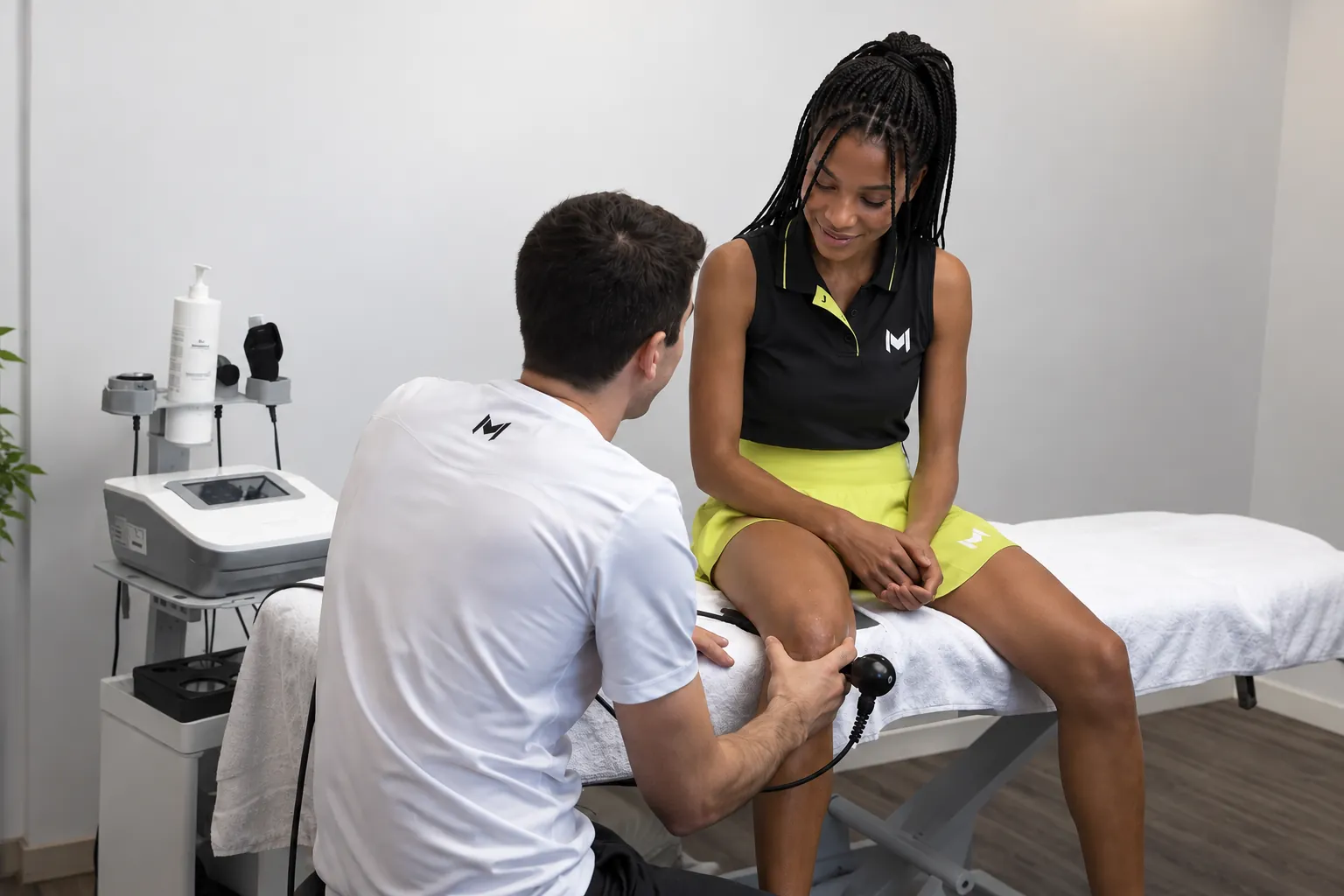
If pain sets in, get it checked: our sports medical center looks after injured players.
At the Mouratoglou Academy on the French Riviera (Biot, near Nice), coaches advise most campers against Kevlar, except heavy string-breakers with a sound technique. The Mouratoglou Method always starts from the player. Discover the Academy.
Alternatives to Kevlar for string-breakers
If you break strings very often, Kevlar is not the only answer. Before choosing the stiffest string on the market, try options that are kinder to the arm.
- A thicker polyester (1.30 mm gauge or more): more durable, with a less harsh feel than Kevlar.
- A polyester / multifilament hybrid: polyester durability in the mains, comfort in the crosses.
- A denser string pattern (18x20): the strings move less and wear more slowly.
Your racquet matters too: see our guide on how to choose a tennis racquet.
Frequently asked questions
Are Kevlar strings suitable for beginners?
No. Very stiff and low-powered, they require you to generate your own ball speed and send a lot of vibration into the arm. A beginner will be much better served by nylon or multifilament.
Can you play with a full Kevlar string bed?
It is possible but rare, as stiffness is then at its maximum. Most players use Kevlar in a hybrid, with Kevlar mains and a soft string in the crosses, to limit discomfort.
Does Kevlar give more power?
No. It returns little energy to the ball: it is a durability and control string. For more power, a multifilament or natural gut at a lower tension is a better fit.
Is Kevlar bad for your arm?
It is not dangerous in itself, but its stiffness increases vibration and the risk of tennis elbow for players who are not used to it or whose technique is still developing. In a hybrid and at a lower tension, the risk is reduced.
Why do I keep breaking my tennis strings?
Frequent breakage mostly comes from heavy topspin: the strings slide and rub against each other, then wear through at the crossings. An open string pattern and a thin gauge speed this up. Before changing strings, have your technique checked: at the Performance Camp Adult, the coach also reviews your equipment.