Equipment · Racquets
How to choose a tennis racquet: the complete guide
To choose a tennis racquet, look at six criteria: weight, head size, balance, stiffness, string pattern and grip size. A beginner should go for a light racquet (250 to 290 g) with a large head; an experienced player for a heavier, more precise frame. The right racquet is the one that matches your level, your build and the way you play.

Key takeaways
- Weight: 250–290 g to start, 290–320 g for an intermediate player, over 320 g for an advanced player with sound technique.
- Head size: over 660 cm² (102 sq in) for forgiveness and power, under 645 cm² (100 sq in) for control and precision.
- Balance: head-heavy for power, head-light for manoeuvrability and control.
- Stiffness: a stiff frame (RA above 70) is powerful but transmits more vibration; a flexible frame (RA below 65) is kinder to the arm.
- Grip size: leave room for one finger between your fingertips and palm; if in doubt, take the smaller size and add an overgrip.
How to choose a tennis racquet: where to start?
Your racquet is an extension of your arm. The wrong one tires you out, causes pain and holds back your progress; the right one makes hitting more comfortable and more effective. There is no perfect racquet for everyone, but there is one that suits your profile.
Before reading spec sheets, ask yourself three questions: what is my level (beginner, intermediate, advanced)? How do I play (baseline power, control, variety, net play)? Do I have any weak spots (elbow, wrist, shoulder)? The answers guide every criterion below.
| Level | Weight (unstrung) | Head size | String pattern |
|---|---|---|---|
| Beginner | 250 to 290 g | Over 660 cm² | Open (16x19) |
| Intermediate | 290 to 320 g | 645 to 660 cm² | Open (16x19) |
| Advanced / competition | Over 320 g | 645 cm² or less | 16x19 or dense (18x20) |
What racquet weight should you choose?
Weight comes first. It determines how stable the racquet is at impact, how much power you can produce and how tired your muscles get. Too heavy and it is hard to swing fast; too light and it gets pushed around by fast balls.
- Light racquets (250 to 290 g): easy to manoeuvre and quick to swing. Ideal for beginners, juniors moving up to an adult frame and players who like a fast game.
- Mid-weight racquets (290 to 320 g): the best compromise between power and control, for regular players who want a heavier ball while staying quick.
- Heavy racquets (over 320 g): stable and powerful, but they require solid technique and good fitness. The downside: less manoeuvrability and more fatigue over a long match.
Which head size: forgiveness or precision?
The head is the strung area that meets the ball. Its size determines forgiveness (your margin for error when you miss the sweet spot) and control.
- Oversize head (over 660 cm² / 102 sq in): a big hitting zone, fewer mishits and more power, because the strings deflect more. Perfect for beginners.
- Midplus head (645 to 660 cm² / 100–102 sq in): today’s standard, balancing forgiveness and precision. It suits most intermediate and advanced players.
- Midsize head (under 645 cm² / 100 sq in): maximum control for experienced players who find the centre consistently, but off-centre hits are punished quickly.
Balance and stiffness: power, control or comfort?
Balance
Balance describes how the weight is spread between head and handle. A head-heavy racquet carries more mass at the top: it helps you hit a heavy, fast ball, but it is a little less manoeuvrable. A head-light racquet is quicker and more precise, popular with players who vary spin or come to the net; on the other hand, it takes more effort to generate power.
Stiffness
Frame stiffness is measured in RA. A stiff frame (RA above 70) barely bends at impact and returns more energy: it is powerful but sends more vibration into the arm. A flexible frame (RA below 65) absorbs shock better and protects the elbow, at the cost of some power. If your elbow is sensitive, read our guide to choosing a racquet for tennis elbow.
| Criterion | More power | More control / comfort |
|---|---|---|
| Balance | Head-heavy | Head-light |
| Stiffness | Stiff (RA > 70) | Flexible (RA < 65) |
| Head size | Large | Small |
| String pattern | Open (16x19) | Dense (18x20) |
String pattern: open or dense?
The string pattern gives the number of main and cross strings. An open pattern (16x19) lets the strings move more: the ball stays on the stringbed longer, which makes topspin easier and adds power. The strings wear out faster, though. A dense pattern (18x20) gives more control and suits flat hitters, but takes more effort to generate spin.
The racquet is only half the story: string type and tension change the feel enormously. To go further, see our guide to tennis strings and our advice on choosing your string tension.
 AdultsFull daysAll levelsPerformance Camp AdultA week of intensive tennis, 4 players per coach: technique, match play, physical and mental training.DISCOVER
 What racquet length and grip size do you need?
The standard adult length is 68.5 cm (27 inches). Junior racquets are shorter: from 43 cm (17 inches) for toddlers to 66 cm (26 inches) around the age of 10 to 12. For a child, follow our guide to choosing a junior racquet.
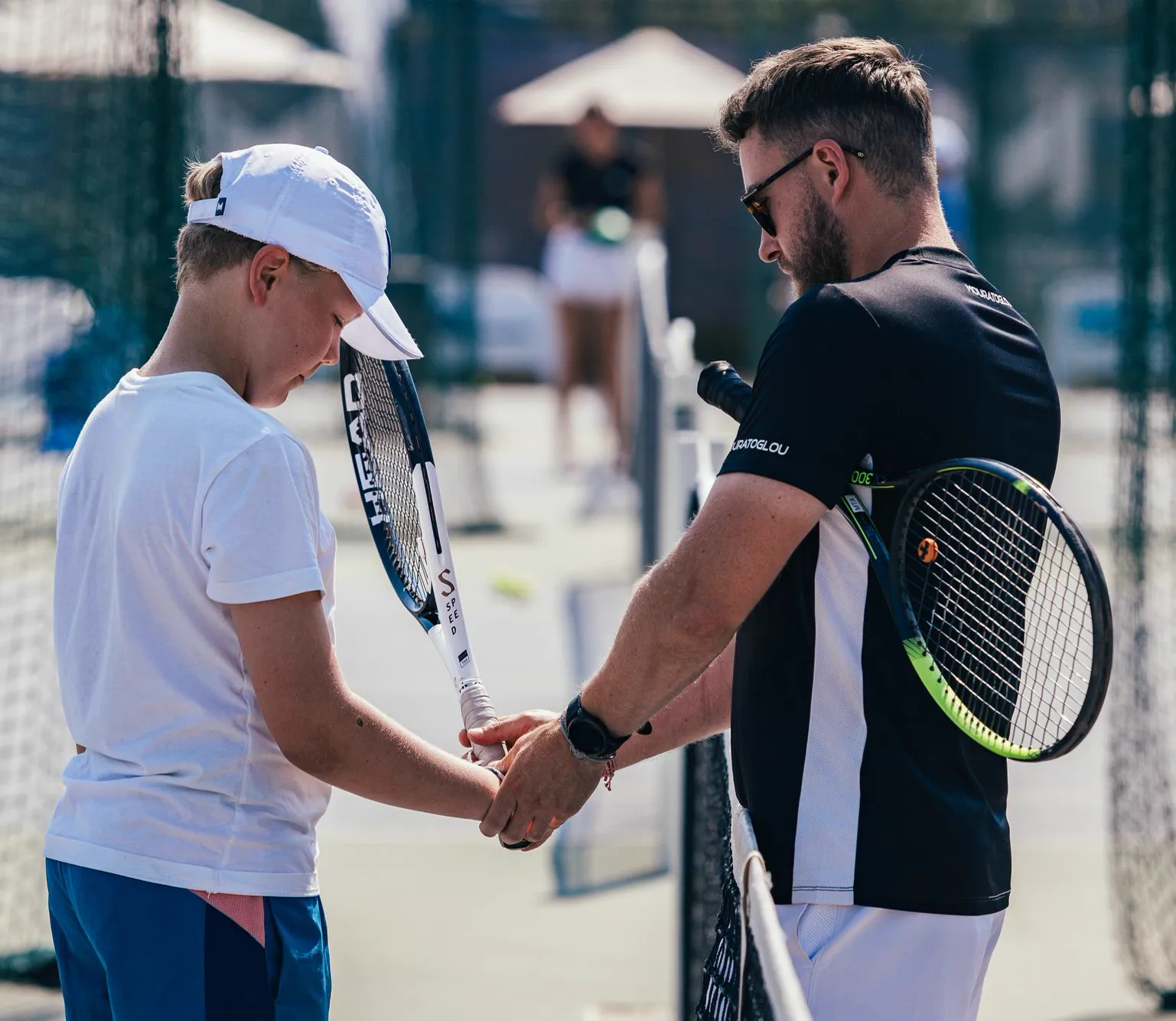
Grip size depends on your hand. Too small and you squeeze, which leads to pain; too big and your wrist locks. In Europe sizes run from L0 to L5 (4 to 4 5/8 inches); most women play with L1–L2 and most men with L2–L3. The full measuring method is in our article on racquet grip size.
How do you confirm your choice before buying?
- Define your profile: level, style, how often you play, any aches and pains.
- Shortlist 2 or 3 racquets within the weight and head-size range for your level.
- Test them on court, ideally for a full session: forehand, backhand, serve and volley.
- Compare how they feel: ease of acceleration, stability against fast balls, how your arm feels at the end.
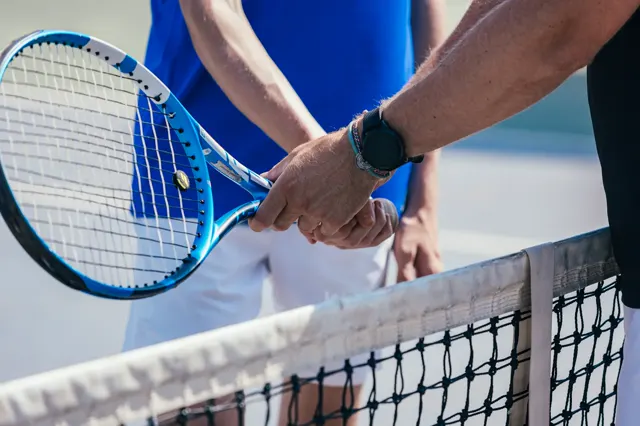
- Ask your coach, who sees your stroke from the outside.
A camp is often the perfect time to review your equipment: with 4 players per coach, our coaches quickly spot a racquet that is too heavy or a grip that is the wrong size. That applies to the Player Camp Adult as well as our junior camps.
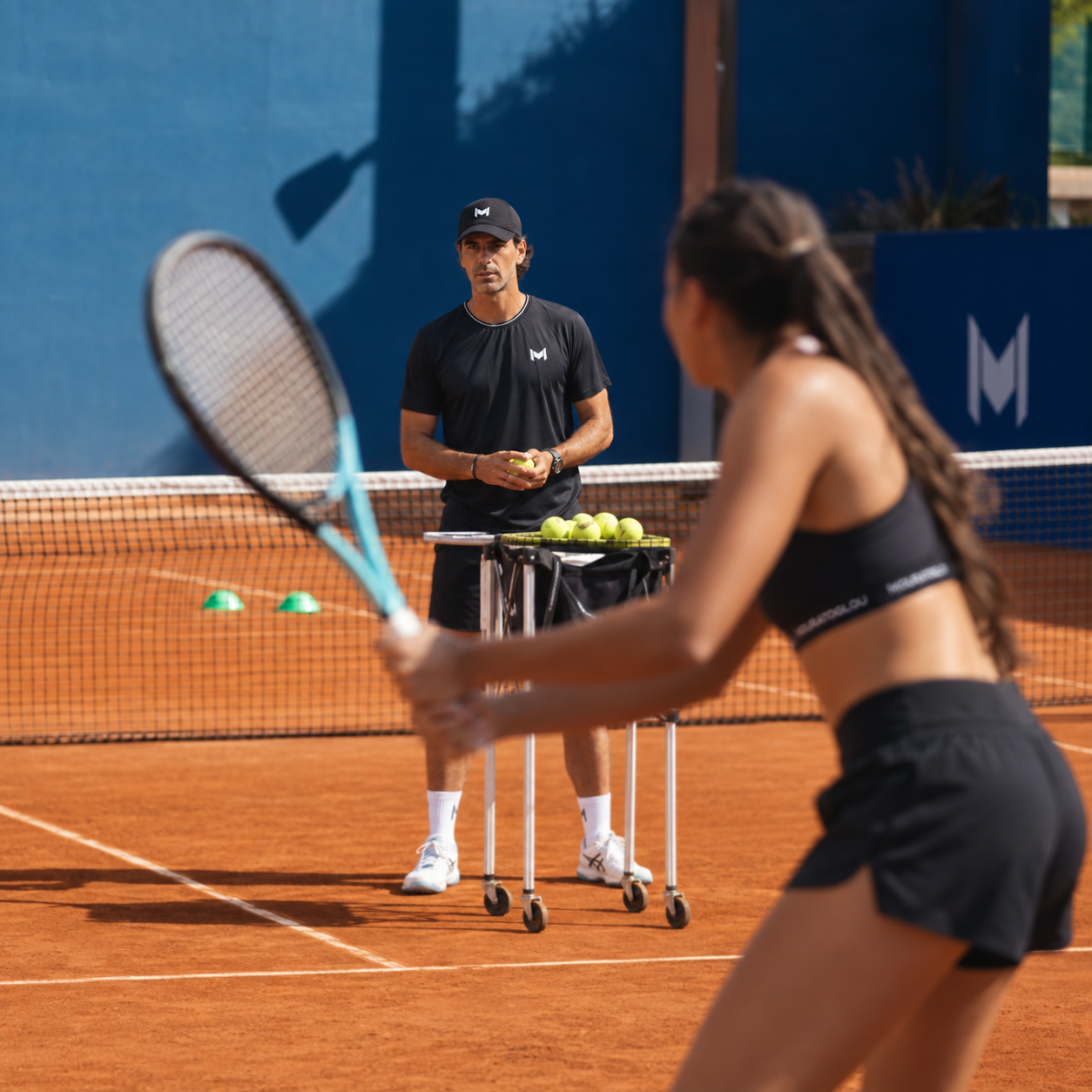
At the Mouratoglou Academy on the French Riviera (Biot, near Nice), coaches watch your stroke before talking equipment: in the Mouratoglou Method, the racquet adapts to the player, not the other way round. A tennis camp is the ideal moment to test several frames in real conditions, with an expert eye.
Frequently asked questions
What is the best tennis racquet for a beginner?
A light racquet (250 to 290 g) with a large head (over 660 cm²) and an open string pattern (16x19). It forgives mishits, helps you generate power and does not tire your arm.
How do I know if my racquet is too heavy?
If your arm tires quickly, you struggle to accelerate or you are often late on the ball, it is probably too heavy. A well-suited racquet should not cause excessive fatigue after a normal session.
Should I prioritise power or control?
It depends on your game. If your balls land short, look for power (larger head, head-heavy balance, stiffer frame). If you hit long too often or like to place the ball, choose control (smaller head, head-light balance, dense pattern).
Does the string pattern affect string life?
Yes. An open pattern (16x19) wears strings faster because they move and rub against each other more. A dense pattern (18x20) lasts longer but produces less spin.
What length of racquet does an adult need?
The standard length is 68.5 cm (27 inches). Extended racquets exist, but almost all adult players use the standard length.