Equipment · Racquets
Tennis racquet grip size: how to choose the right one
Your tennis racquet grip size depends on your hand: holding the racquet, there should be room for one finger between the tip of your ring finger and your palm. Sizes run from 4 to 4 5/8 inches (L0 to L5 in Europe); most women play with 4 1/8–4 1/4 and most men with 4 1/4–4 3/8. If in doubt, choose the smaller size: you can always build it up with an overgrip.

Key takeaways
- Finger test: with your hand closed around the handle, the index finger of your other hand should just fit between your ring fingertip and palm.
- Sizes: 4 inches (L0) to 4 5/8 inches (L5), each size adding 1/8 inch (about 3 mm) of circumference.
- Benchmarks: L1–L2 for most women, L2–L3 for most men, L4–L5 for large hands.
- Between two sizes: take the smaller one and add an overgrip, which adds roughly half a size.
- Wrong size: too small makes you squeeze and encourages tennis elbow; too big locks the wrist.
How do you measure tennis racquet grip size?
Two simple methods will give you the right grip size. They complement each other: the first is done with a racquet in hand, the second with a ruler.
Method 1: the finger test
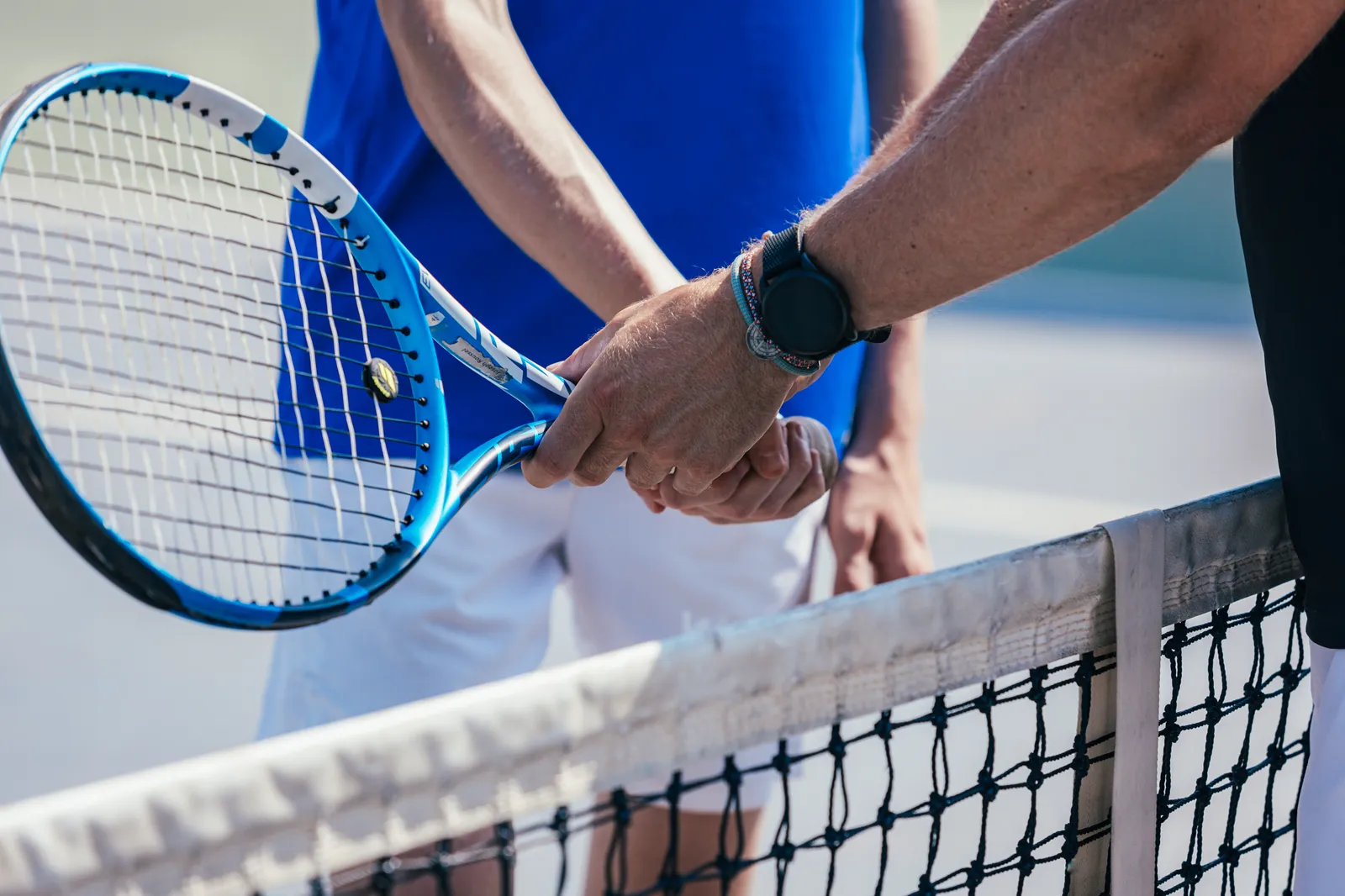
- Pick up the racquet in your dominant hand with a forehand grip (semi-western or continental).
- Close your hand naturally around the handle without squeezing.
- Slide the index finger of your other hand into the gap between the tip of your ring finger and your palm.
- Read the result: if the finger just fits, the size is right. If your ring finger touches your palm, the handle is too small. If the gap is clearly wider than a finger, it is too big.
Method 2: the ruler
With your hand open and fingers together, measure from the middle crease of your palm (the second horizontal line) to the tip of your ring finger. The result, in inches or millimetres, roughly matches the handle circumference you need: check it against the chart below.
What do L1, L2 and L3 mean? The grip size chart
Grip sizes are labelled L0 to L5 in Europe and in inches in the US. The system is the same across all major manufacturers: the size is the circumference of the handle, including the factory grip.
| European size | US size | Approx. circumference | Who for? |
|---|---|---|---|
| L0 | 4 in | ≈ 101 mm | Juniors, very small hands |
| L1 | 4 1/8 in | ≈ 105 mm | Many women |
| L2 | 4 1/4 in | ≈ 108 mm | Women and men with average hands |
| L3 | 4 3/8 in | ≈ 111 mm | Many men |
| L4 | 4 1/2 in | ≈ 114 mm | Large hands |
| L5 | 4 5/8 in | ≈ 117 mm | Very large hands (rare) |
These benchmarks do not replace the test: two people of the same height can have very different hands. Junior racquets come with a slim handle of their own (sometimes marked L00 or L000): see our guide to choosing a junior racquet.
What happens if your grip is the wrong size?
A grip that is too small
The racquet twists in your hand on off-centre hits, and you compensate by squeezing harder. That tension loads the forearm muscles and tendons and encourages tennis elbow. If your elbow already hurts, read our advice on choosing a racquet for tennis elbow.
A grip that is too big
The wrist loses mobility: it becomes harder to change grips quickly (essential at the net and on the serve), to hit topspin and to whip the racquet head through. The hand also tires faster, leading to cramps and blisters.

Which grip size suits your playing style?
For the same hand size, your style of play can tip the balance between two sizes:
- Heavy topspin players: a slightly slimmer handle frees the wrist and makes spin easier, especially with a western grip.
- Flat hitters and slicers: a slightly thicker handle feels more stable and limits twisting on off-centre hits.
- Net players and serve-volleyers: a handle that is not too thick makes quick grip changes between forehand, backhand and continental easier.
Grip size is only one criterion: weight, head size, balance and stiffness matter just as much. Find them all in our guide on how to choose a tennis racquet.
 AdultsMorningsAll levelsPlayer Camp AdultCoached tennis mornings to progress at your own pace, with afternoons free on the French Riviera.DISCOVER
 Why use an overgrip?
An overgrip is a thin tape wrapped over the factory grip. It is cheap, takes two minutes to change and brings four benefits:
- Better tack: the racquet does not slip in your hand, even on big swings.
- More comfort: the extra layer dampens a little vibration and reduces hand fatigue.
- Sweat absorption: your hand stays dry and your grip stable in hot weather.
- Protects the factory grip: the overgrip wears out instead, so you replace the base grip far less often.
Regular players change it often, as soon as it turns smooth or starts to tear. At the net, your grip should stay the same between volleys: for hand landmarks, see our article on the hammer grip.
On a camp at the Mouratoglou Academy on the French Riviera (Biot, near Nice), coaches often check grip size in the very first session: the wrong handle explains many unstable grips and sore arms. In the Mouratoglou Method, equipment is part of individualisation, just like technique. If you are changing racquet, our guide to choosing a tennis racquet completes this measurement. More about our camps.
Frequently asked questions
What grip size should a woman use?
Most adult women use 4 1/8 or 4 1/4 inches (L1 or L2). The finger test is still the reference: with your hand closed on the handle, the index finger of your other hand should just fit between ring finger and palm.
What grip size should a man use?
Most adult men use 4 1/4 or 4 3/8 inches (L2 or L3), and 4 1/2 or even 4 5/8 for large hands. Always check with the finger test or the ruler method.
Does an overgrip change the grip size?
Yes, slightly: an overgrip adds roughly half a size. That is why you should pick the smaller size when in doubt, then adjust with one or two overgrips.
Can you make a grip that is too big smaller?
Only marginally. You can replace the factory grip with a thinner one, but you cannot reduce the frame itself. So it is better not to buy a handle that is too big.
How do you choose grip size for a child?
Junior racquets (19 to 26 inches) almost all come with an L0 or slim handle suited to small hands. What matters most is racquet length and weight, chosen according to the child’s height. When they move up to an adult racquet, around age 11 to 13, measure the hand as described above. Our coaches check this in the Player Camp Junior.