Technique · Racquet grips
The continental grip in tennis: the competitor’s all-round grip
The continental grip in tennis places the base of the index finger on the upper bevel of the handle, which sets the racquet face almost perpendicular to the ground. In competition it is the grip for the serve, volley, smash, slice and drop shot: master it and you can play every touch shot without changing your hand.

Key takeaways
- Position: base of the index finger and heel of the hand on bevel 2 (right-hander); the “V” between thumb and index finger points to the left shoulder.
- Match shots: serve (flat, slice, kick), volley, half-volley, smash, slice, drop shot, defensive lob and block return.
- Competitive edge: no grip change at the net and natural pronation on the serve, so more speed and variety.
- Limit: too little topspin for a baseline forehand, which is played with a semi-western or western grip.
- Fine-tuning: a slight shift towards the backhand helps the slice and low volley; a slight shift towards the forehand helps the high volley.
What is the continental grip in tennis?
The continental grip is a way of holding the racquet with the base of the index finger and the heel of the hand on the upper right bevel of the handle (upper left for a left-hander). The racquet face ends up almost perpendicular to the ground, neither open nor closed: it is the most neutral grip in tennis.
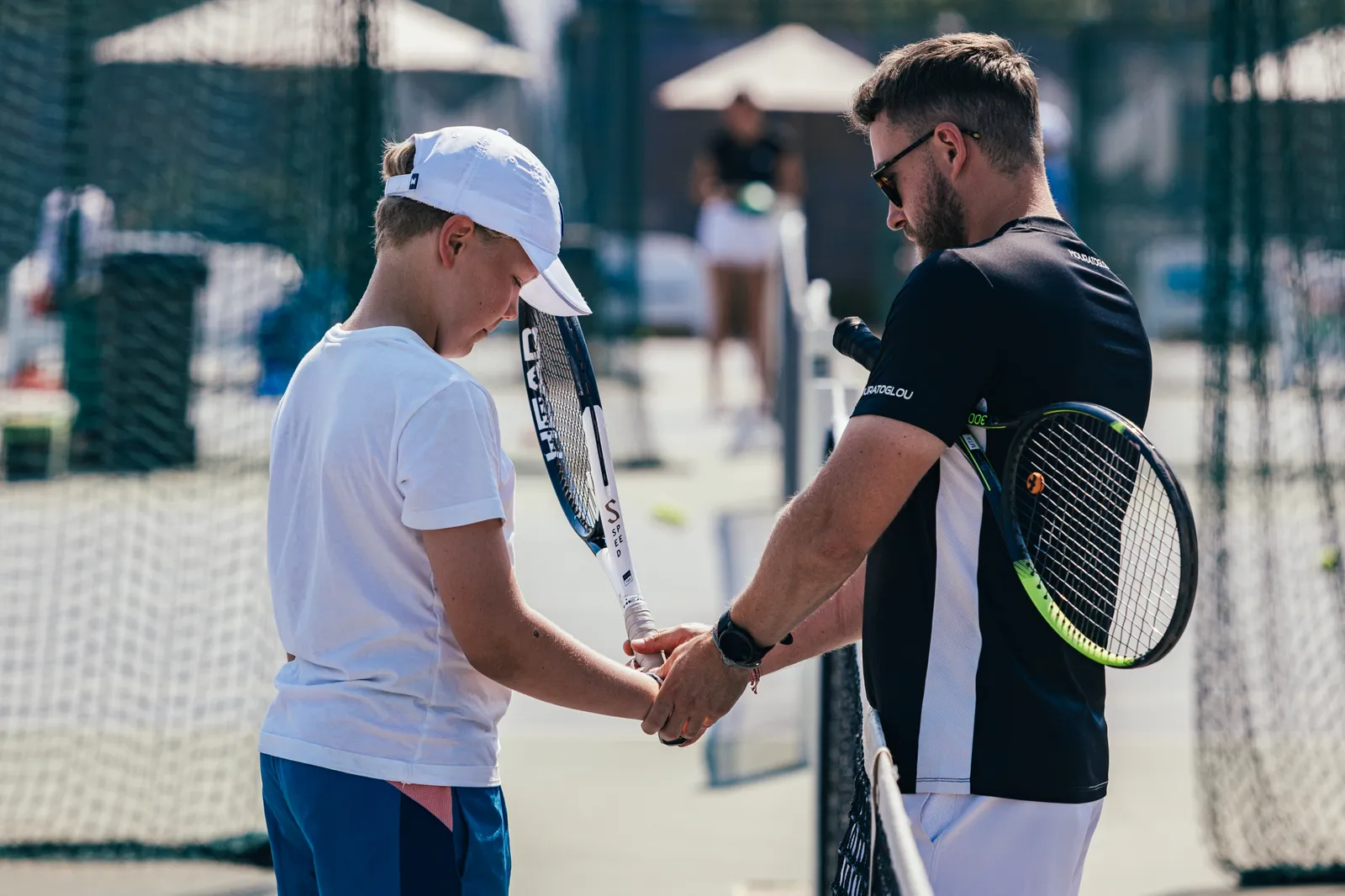
It is very close to the hammer grip, which players learn in their first lessons by picking up the racquet like a tool. If you are just starting out, read our guide to the hammer grip first: it explains hand placement step by step. Here we focus on what competitive players do with it: fine adjustments, match shots and switching between grips.
Why competitive players cannot do without it
At a high level, time is short. At the net, a volley reaches you in under a second: there is no time to switch between a forehand and a backhand grip. The continental grip lets you play both sides with the same grip, simply steering the racquet face with the wrist and forearm.
On the serve, it allows forearm pronation, the rotation that whips the racquet head through just before contact. Without it, the serve stays “pushed” and soon hits a ceiling. It also opens the face slightly on low balls, making backspin easy on the slice and drop shot.
| Shot | Why continental | Key point in a match |
|---|---|---|
| Flat serve | Maximum pronation | Hit at the top of the toss, in front |
| Slice serve | Brushes the side of the ball | Toss slightly to the right (right-hander) |
| Kick serve | Brushes up the back of the ball | Toss above the head, back arched |
| Volley and half-volley | No grip change | Stable face, short swing |
| Smash | Same mechanics as the serve | Get under the ball, free arm up |
| Slice and drop shot | Slightly open face | High-to-low swing, soft hands |
| Block return | Quick reaction on both sides | Shorten the backswing |
On the serve: one grip, three spins
The continental grip is the basis of every competitive serve. What changes from one serve to another is not the grip but the toss and the racquet path: on a flat serve the racquet meets the ball squarely; on a slice it brushes the outside of the ball; on a kick it brushes up the back of it.
Experienced servers often shift their hand one notch towards the backhand (between continental and eastern backhand) to find even more spin on the second serve. Make that change gradually, ideally with a coach. For the whole motion, see our article on serve technique.
At the net: volley, half-volley and smash
At the net, keep the continental grip between shots. On a high volley the hand can slide very slightly towards the forehand to close the face a touch; on a low volley or half-volley, a slight shift towards the backhand opens the face and helps lift the ball. These micro-adjustments are made with the fingers, without letting go of the handle.
The smash follows the same mechanics as the serve: shoulders side-on, free hand pointing at the ball, pronation at contact. More in our guides to the volley and the smash.

From the baseline: slice, drop shot, defence and return
From the back of the court, the continental grip is mainly about variety: a backhand slice that stays low, a sliced forehand to break the rhythm, or a disguised drop shot. It is also invaluable in extreme defence, when you are stretched wide and only the wrist can send the ball back high and deep.
Against a big serve, many players keep a grip close to continental to block the return on both sides. For a heavy topspin forehand, however, you need a more closed grip: see our guide to forehand grips and our complete forehand guide.
Changing grips quickly: the key at a high level
A competitive player constantly switches between continental and their forehand or backhand grip. These changes need to become automatic:
- Return to the ready position with your non-dominant hand on the throat of the racquet: that hand turns the handle.
- Change grip during the preparation, not at contact: as soon as you recognise the shot you are going to play.
- Find the bevels by feel: with practice, the index knuckle “feels” bevel 2 without looking.
- Approach the net in continental: switch on your last approach step, before the split-step.
 Ages 9–172 weeksCoached tournamentsTournament Camp JuniorTwo weeks of training and tournaments, with a coach by your side during matches.DISCOVER
 Three drills to master it in match play
- Continental-only mini-tennis: 5 minutes at the start of every session, playing sliced forehands and backhands without changing grip. Ideal for touch.
- Cross-court volley rallies: volley exchanges at the net with the continental grip only, alternating forehand and backhand. Target: 20 volleys without a miss.
- Serve and volley: link the serve and the first volley without changing grip. This automatism is at the heart of net play: it is the basis of serve and volley.
At camp, our coaches correct these grip changes with 4 players per coach, on the Performance Camp Adult or the Performance Camp Junior.
At the Mouratoglou Academy on the French Riviera (Biot, near Nice), the continental grip is drilled from the first days of camp, on serves and volleys. It is a fundamental of the Mouratoglou Method. Discover our tennis camps.
Frequently asked questions
What is the difference between the continental grip and the hammer grip?
Both describe the same family of grips, with the hand on the upper bevel of the handle. The hammer grip is the learning version, the most neutral one; for competitive players, the continental grip includes small shifts depending on the shot (kick serve, low volley). Our article on the hammer grip explains the basic hand position.
Can you play all your tennis with the continental grip?
Not in the modern game. It suits the serve, net play, slice and defence, but it gives too little topspin for a consistent baseline forehand or backhand. Competitive players combine the continental grip with a semi-western forehand grip.
Why does my serve lack power with the continental grip?
At first, the continental grip feels like hitting with the edge of the racquet, and many players slow their swing down. Power comes from forearm pronation and a fast, relaxed arm: it takes a few weeks of practice before the motion flows.
Which grip should I use to return a fast serve?
Against a very fast serve, a grip close to continental lets you block the ball on both sides with a short swing. Against a slower serve, go back to your usual forehand or backhand grip so you can hit through the ball.
How do I check that I am holding the continental grip correctly?
Rest the racquet on its edge and hold it like a hammer: the V between thumb and index finger should sit on the upper-left bevel of the handle (for a right-hander). On a volley, the face should be slightly open without bending the wrist. At the Performance Camp Junior, the coach checks this from the first session.