Equipment · Racquets
Tennis elbow racquet: how to choose one that spares your elbow
A good racquet for tennis elbow has a fairly flexible frame (RA below 65), a moderate weight (280 to 300 g), a head-light balance, a mid to large head and soft strings. This set-up reduces the vibration reaching your elbow. It does not replace sound technique, or medical advice if the pain persists.

Key takeaways
- Tennis elbow (lateral epicondylitis) is irritation of the tendons attached to the outside of the elbow, caused by repeated movements and impact.
- Flexible frame: an RA below 65 absorbs vibration better than a stiff frame (RA above 70).
- Moderate weight, head-light balance: 280 to 300 g, heavy enough to stay stable, light enough not to tire the arm.
- Strings: multifilament or natural gut at a lower tension; avoid stiff polyester monofilament.
- Everything else counts too: grip size, technique, warm-up and rest.
Can a racquet cause tennis elbow?
Yes, an unsuitable racquet can trigger or worsen tennis elbow. Tennis elbow, or lateral epicondylitis, is pain on the outside of the elbow caused by overloading the tendons of the wrist extensor muscles. It usually comes from repeated, poorly executed strokes, but equipment directly affects the shock and vibration your arm absorbs.
- Frame stiffness: the stiffer the frame, the more vibration reaches the arm on every hit.
- Weight: too heavy and it tires the forearm; too light and it gets pushed around by the ball and passes on more of the shock.
- Balance: a very head-heavy racquet adds power, but also load on the elbow; a head-light balance is kinder to the arm.
- Grip size: a handle that is too small forces you to squeeze and overloads the tendons.
- Strings: hard or overly tight strings send the shock back into your arm instead of absorbing it.
Which racquet should you choose for tennis elbow?
| Criterion | Recommendation | Why |
|---|---|---|
| Stiffness | Flexible, RA below 65 | The frame absorbs part of the vibration |
| Weight | 280 to 300 g | Stable without overloading the forearm |
| Balance | Even to slightly head-light | Less load on the elbow at contact |
| Head size | Mid to large (100–105 sq in) | More forgiveness on off-centre hits |
| String pattern | Open (16x19) | A softer, more comfortable stringbed |
| Grip | Exactly your size | Stops you squeezing the handle |
A flexible frame
A frame with a stiffness below 65 RA bends a little more at impact and soaks up part of the shock. You lose some power, but your elbow takes less vibration. It is the single most important criterion.
A mid to large head
A larger head (around 100 to 105 square inches, or 645 to 680 cm²) widens the effective hitting zone. Off-centre hits, which cause the strongest vibration and twisting, are better cushioned.
Does a lighter racquet help with tennis elbow?
Not necessarily. A lighter racquet is easier to swing and tires the arm less. But if it is too light, it lacks the mass to absorb the impact of the ball: your arm takes more of the shock and you have to force to create power, which can keep the injury going.
The best compromise is a moderate weight of 280 to 300 g, with an even or slightly head-light balance and soft strings. To see how these figures compare with other player profiles, read our guide on how to choose a tennis racquet.
Which strings are best for tennis elbow?
Strings matter as much as the racquet. Some send far more vibration back into the arm than others:
- Natural gut: the most comfortable, with the best shock absorption. It is more expensive and less durable, but remains the benchmark for a sensitive arm. See our article on natural gut strings.
- Multifilament: made of thousands of microfibres, it offers comfort close to gut at a more reasonable cost. Often the best everyday choice.
- Polyester (monofilament): very stiff, valued for control and durability, but best avoided if your elbow hurts, or kept to the mains in a hybrid set-up.
- Tension: drop it by 1 to 2 kg (2 to 4 lb) from your usual tension; a softer stringbed absorbs impact better.
For reference tensions, read our advice on choosing your string tension.
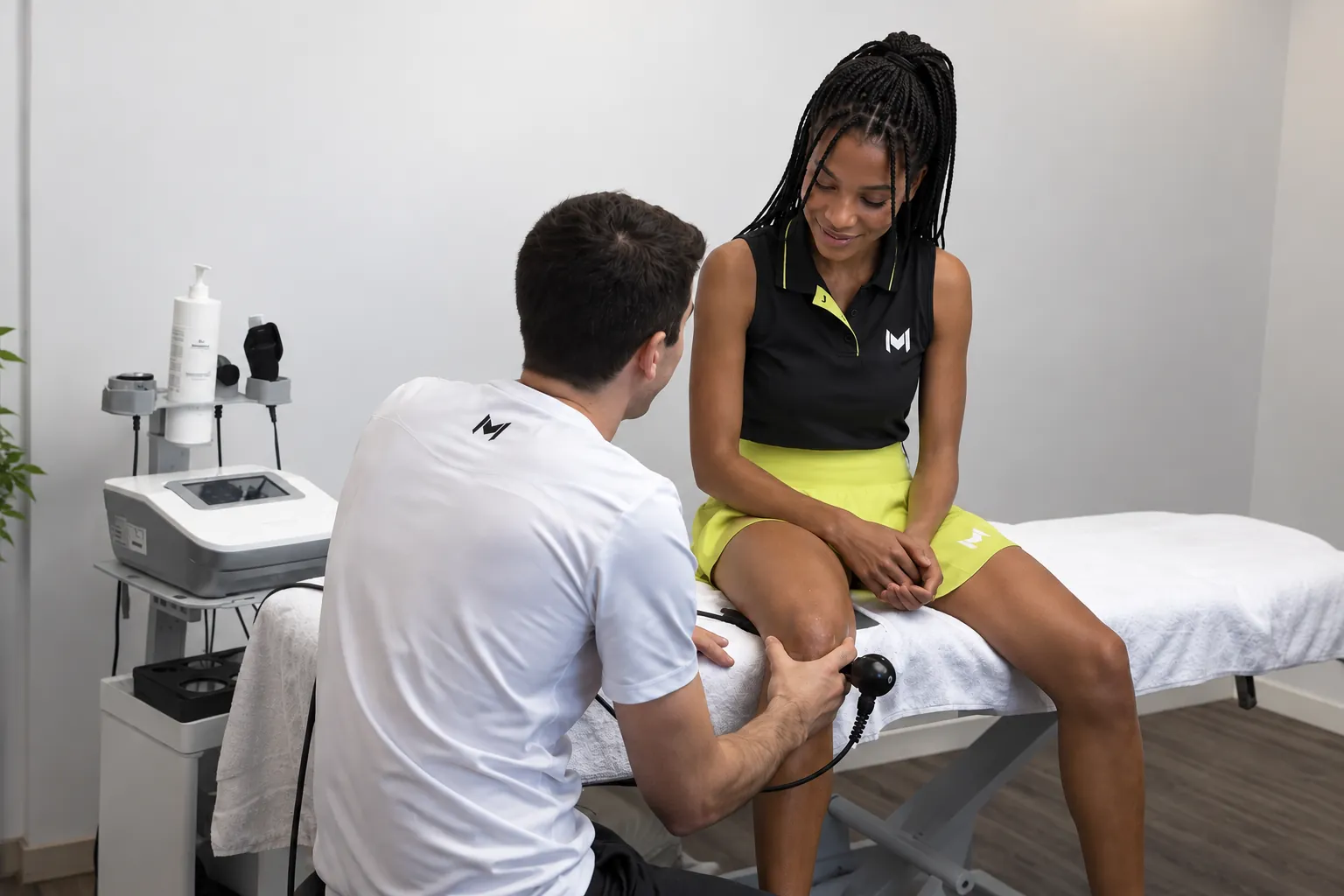 PreventionCareRecoverySports Medical CenterDoctors, physiotherapists and trainers on campus to prevent injuries and recover well.DISCOVER
 How do you prevent and relieve tennis elbow?
- Fix your technique: hitting late with a broken wrist, or leading with the elbow on a one-handed backhand, overloads the tendons. A coach spots these faults quickly.
- Warm up: a few minutes mobilising wrists, forearms and shoulders before you hit hard.
- Relax your hand: hold the racquet loosely, without tension between shots.
- Add a dampener: it reduces string vibration and improves comfort. See where to put a vibration dampener.
- Listen to the pain: reduce your load, space out sessions and see a doctor or physiotherapist if the pain lasts more than a few days.
At the Mouratoglou Academy, the Sports Medical Center looks after injured players, from treatment through to their return to tennis. For other common injuries, read our article on managing injuries.
At the Mouratoglou Academy on the French Riviera (Biot, near Nice), the Sports Medical Center and the coaches work together: the Mouratoglou Method holds that a sore elbow is fixed through equipment, technique and playing load at once. See also where to put a vibration dampener, grip size and our guide to tennis injuries. Discover the academy.
Frequently asked questions
What is the best racquet for tennis elbow?
There is no single model, but there is a profile: a flexible frame (RA below 65), 280 to 300 g, an even or slightly head-light balance, a mid to large head and the right grip size. Try several racquets that fit this profile.
Should I stop playing tennis with tennis elbow?
Not always, but you should reduce your load while the pain is there and get a medical assessment if it persists. Playing through the pain often drags the injury out for months.
Is polyester string bad for your elbow?
It is the stiffest string, so the least comfortable for a sensitive elbow. With tennis elbow, choose multifilament or natural gut, or at least a hybrid with a soft string, and a lower tension.
Is a vibration dampener enough to prevent tennis elbow?
No. It reduces string vibration and improves comfort, but its effect on the frame is limited. It complements the right racquet, the right strings and sound technique.
Can a coach help relieve tennis elbow?
Yes, by fixing the technical causes: late contact, a tense wrist, a one-handed backhand led by the elbow. A coach also checks your grip and handle size. This work complements medical treatment rather than replacing it. At the academy, coaches and the Sports Medical Center physiotherapists coordinate during camps.