Equipment · Shoes
Clay court tennis shoes: how to choose the right pair
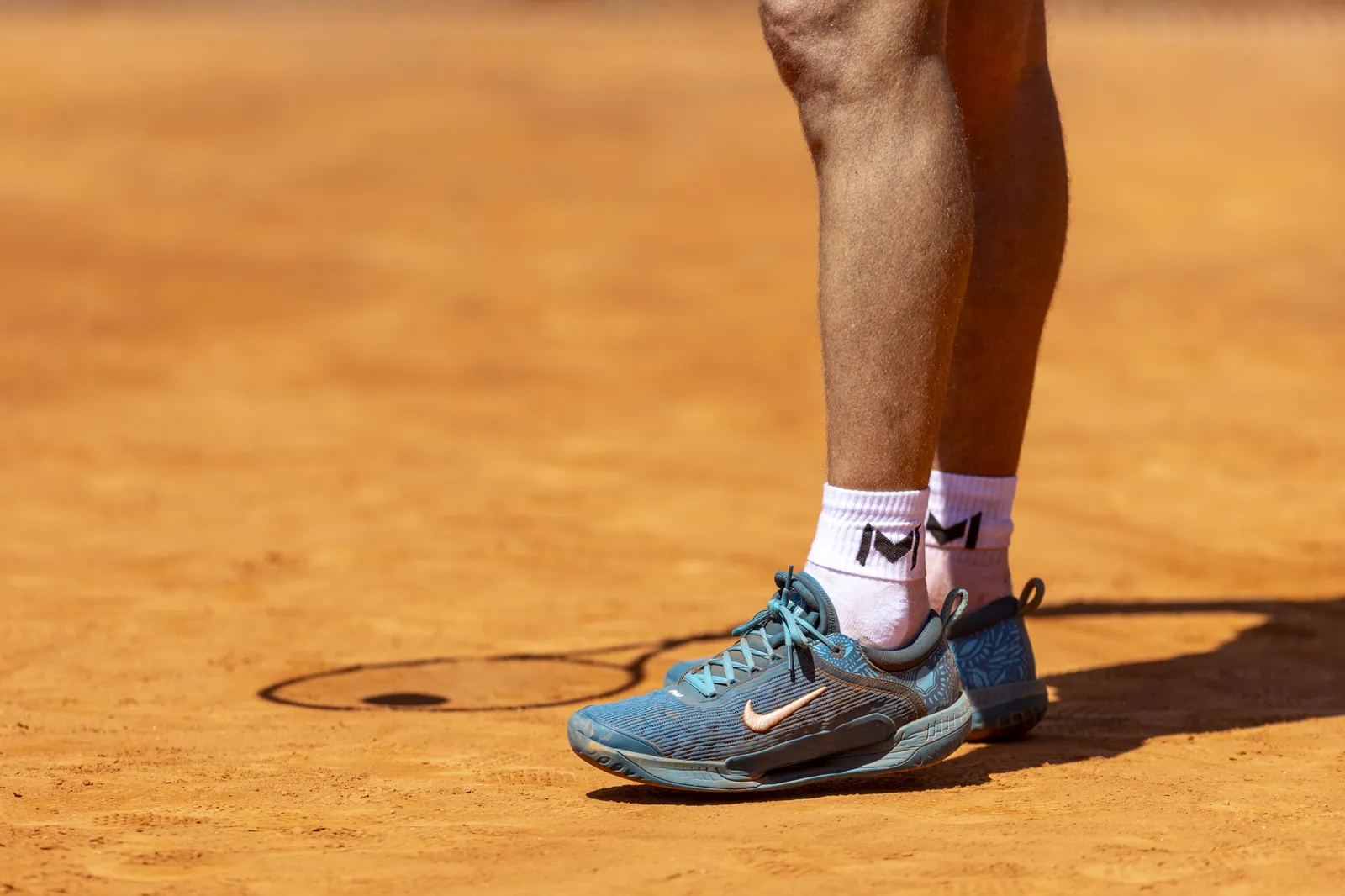
A good clay court tennis shoe has a full herringbone outsole (a zigzag pattern) that grips the surface, allows controlled sliding and sheds clay. It also needs firm lateral support for pushing off and sliding, and comfortable cushioning for long rallies. A hard-court shoe grips less well on clay and clogs up.

Key takeaways
- Herringbone outsole: the zigzag pattern grips the clay, allows sliding and does not trap clay in its grooves.
- Lateral support: a reinforced upper and a well-held heel limit the risk of a sprained ankle when sliding.
- Cushioning: clay is soft underfoot, but rallies are long; comfortable cushioning reduces fatigue.
- Fit: foot held firmly, heel that does not lift, about half a centimetre in front of the big toe.
- Replacement: every 4 to 6 months if you play several times a week, as soon as the herringbone is worn.
Why do you need specific tennis shoes for clay?
Clay is a loose, slippery surface: a thin layer of crushed brick sits on a firmer base. You move differently on it, sliding into your shots to reach the ball and recover. A shoe designed for clay gives you three things:
- Grip to start and stop without spinning your wheels.
- Controlled sliding: the outsole must let you slide, but predictably.
- An outsole that does not clog: clay must clear out with every step, otherwise the sole turns smooth and dangerous.
It is also about injury prevention: on clay, sliding puts heavy demands on ankles and knees. A suitable shoe with good lateral support reduces the risk of a sprain. To learn more about the surface itself, read our article on red clay courts.
What makes a good clay court shoe?
A herringbone outsole
This is the deciding factor. The outsole should carry a herringbone pattern (zigzag) across its entire surface. Its grooves grip the clay in the direction you run and let you slide sideways; their open shape sheds clay instead of holding it. A slightly softer rubber improves grip further.
Reinforced lateral support
Slides and changes of direction call for an upper that is firm at the sides, a heel counter that holds the foot well and lacing that locks down the midfoot. Your foot should not move inside the shoe when you brake.
Comfortable cushioning
Clay is easier on the joints than concrete, but rallies are long and matches last. Comfortable cushioning at the heel and forefoot limits fatigue, without being so thick that you lose feel for the ground.
| Criterion | Clay court shoe | Hard court shoe |
|---|---|---|
| Outsole | Full herringbone | Mixed pattern, thick rubber |
| Sliding | Easy and controlled | Poorly suited |
| Sheds clay | Yes | No, the sole clogs |
| Abrasion resistance | Moderate | High |
| Cushioning | Comfortable, good ground feel | More pronounced |
For other surfaces and general criteria (sizing, playing style), see our complete guide to choosing tennis shoes.
How do you get the size and fit right?
- Try them on at the end of the day, wearing your tennis socks.
- Leave about half a centimetre in front of your big toe: when you slide, your foot moves forward in the shoe.
- Check the heel: it should not lift when you walk or side-step.
- Check the width: the foot should be held without being squeezed, especially across the ball of the foot.
- Simulate a slide: push sideways off one foot; the shoe should move with you without your foot rolling over.
 AdultsMorningsAll levelsPlayer Camp AdultCoached tennis mornings to progress at your own pace, with afternoons free on the French Riviera.DISCOVER
 Durability: what should you look out for?
Clay wears outsoles less than hard courts do, but repeated sliding stresses certain areas:
- The forefoot: look for reinforcement at the toe and on the inner side, where the foot drags when sliding and serving.
- Stitching and upper: clay is abrasive and gets everywhere; a well-finished upper lasts longer.
- Depth of the herringbone: the deeper it is to begin with, the longer the shoe keeps its grip.
When should you replace clay shoes, and how do you look after them?
Signs of wear
- The herringbone is smooth, especially under the forefoot: you slide without control.
- The cushioning is flat: you feel impacts more.
- The support has loosened: your foot moves inside the shoe when you slide.
- The upper is torn or the sole is coming away.
If you play several times a week, expect to replace them roughly every 4 to 6 months; for an occasional player, a pair can last much longer. Replace them as soon as the grip is no longer reliable.
Care
- Knock the soles together after each session to remove clay, and brush the grooves with a soft brush.
- Clean the upper with a damp cloth, never in the washing machine.
- Air-dry them out of direct sunlight and away from radiators, with the insoles removed.
- Use shoe trees or newspaper to keep their shape and absorb moisture.
With the right shoes on, the next step is adapting your game to the surface: patience, spin, building the point. Our coaches work on it at the Academy, and we cover it in our article on clay court tactics. For the rest of your kit, see our guide on how to choose a tennis racquet.
To go further, read our general guide to choosing tennis shoes, the grey clay page and all our tennis equipment guides. The clay courts of the Mouratoglou Academy on the French Riviera (Biot, near Nice) are a good place to test your footing, with coaches trained in the Mouratoglou Method.
Frequently asked questions
Can you play on clay in all-court shoes?
Yes, occasionally. But an all-court outsole grips less and clogs more than a full herringbone sole. If you mainly play on clay, a dedicated pair is safer and more effective.
Can you wear clay court shoes on hard courts?
Occasionally, but the outsole will wear out very quickly on an abrasive hard surface, and the cushioning is often less pronounced. It is better to keep your clay shoes for clay.
How do you recognise a clay court shoe?
By its outsole, fully covered in a herringbone (zigzag) pattern. Manufacturers usually label it “clay”.
How often should you replace clay court shoes?
Roughly every 4 to 6 months if you play several times a week, less often if you play little. The real signal is worn herringbone and lost grip.
Which shoes should I bring to a clay court tennis camp?
A well broken-in pair with a herringbone sole, plus a second pair if you play several hours a day: alternating lets the sole and your feet dry out. Avoid breaking in a new pair on day one. Before a Player Camp Adult, check how worn the sole is under the forefoot.