Rules · Faults
Forced error in tennis: understand it, prevent it, fix it
A forced error in tennis is a miss drawn out by the quality of your opponent’s shot: pace, depth, angle or spin put you under so much pressure that you miss. You reduce forced errors by improving your defence, positioning and reading of the game, rather than by playing more cautiously.

Key takeaways
- Definition: a forced error is a miss made under pressure from a good shot by your opponent.
- Key difference: an unforced error is down to you; a forced error mainly reflects your opponent’s merit.
- Typical situations: a very deep ball, a short cross-court angle that pulls you wide, an attack on your weaker side, a well-played pass or lob.
- Remedy: better anticipation, faster recovery, defensive shots (lob, slice, high ball) to buy time.
- Mindset: do not mistake a forced error for a weakness; adjust your tactics, not your confidence.
What is a forced error in tennis?
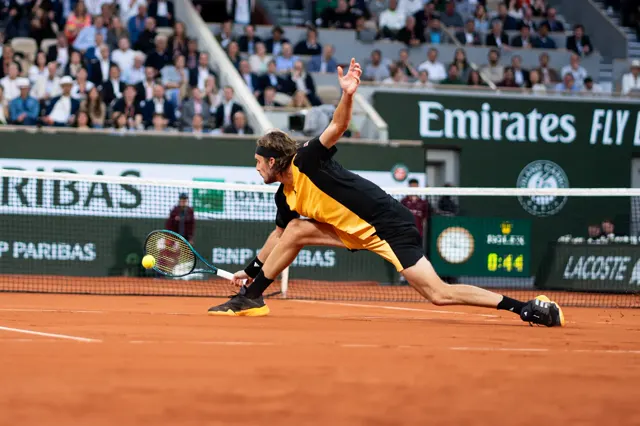
A forced error is a miss you make because your opponent forced you into it. Their ball was too fast, too deep, too angled or too heavy with spin for you to control: you get your racquet on it, but send it into the net or out.
It is the opposite of an unforced error, made on a playable ball under no real pressure. In professional match statistics, a statistician puts every error in one category or the other; the line remains partly a matter of judgement.
A forced error is not a rules matter: it is an ordinary playing error that costs the point like any other. For all the faults defined in the rules (serve, foot fault, touching the net and so on), see our guide to tennis faults.
When do forced errors happen?
- A very deep ball that bounces near your feet and stops you hitting cleanly.
- A short cross-court angle that pulls you well wide and forces you to hit on the stretch.
- An attack on your weaker side, often the high backhand.
- A powerful or well-placed serve that leaves no time to prepare the return.
- A well-played passing shot or lob when you are at the net.
- A change of pace or spin: a low slice after a run of topspin balls, for example.

Forced or unforced error: how do you tell the difference?
Ask yourself three questions after the miss: did you have time to set up? Were you balanced? Was the ball of normal difficulty for your level? If the answer to any of them is no, it was probably a forced error.
| Unforced error | Forced error | |
|---|---|---|
| Origin | Your choice or execution | The quality of your opponent’s shot |
| Incoming ball | Playable, no pressure | Fast, deep, angled or heavy with topspin |
| What to work on | Margin, shot selection, focus | Defence, anticipation, recovery |
| In-match response | Play with more margin | Adjust tactics, do not doubt yourself |
How can you make fewer forced errors?
You cannot eliminate forced errors: a good opponent will always draw some out of you. But you can push back the moment they come by becoming harder to hurt.
- Anticipate: watch your opponent’s position and preparation to read the direction of their shot and move earlier.
- Recover quickly after each shot, to the centre of their possible angles, using side steps. Our article on side-step footwork explains the movement.
- Step back on deep balls rather than taking them at awkward height off the bounce, unless you are comfortable with the half-volley.
- Use defensive shots: a high, deep ball, a low slice, a lob. Their job is to buy time to get back into the point, not to win it.
- Protect your weaker side by shading slightly to hit more forehands, if that is your best shot.
Defensive work is at the heart of our junior and adult camps. The Performance Camp Junior in particular combines fitness, movement and match play for 9 to 17-year-olds.
 Ages 9–17Full daysBoarding optionPerformance Camp JuniorThe intensive camp for young players: technique, tactics, fitness and mindset, 4 players per coach.DISCOVER
 How should you react mentally after a forced error?
Recognising a forced error means accepting that your opponent played well. It is not a sign of weakness in your game, and reacting as you would to an unforced error, by playing more cautiously, would be counter-productive.
The right question is tactical: why is your opponent able to play that shot? If your balls land short, they take control; if you always play to the same area, they settle in. Hit deeper, vary direction and spin to take away their best shots. Our advice on tennis tactics will help you build that plan.
Making fewer forced errors also comes down to solid between-point routines, better relaxation and preparation suited to the match format. The Mouratoglou Method always links these errors to the player’s profile, the work we do on our tennis camps on the French Riviera (Biot, near Nice).
Frequently asked questions
What is a forced error in tennis?
It is a miss made because your opponent’s shot put you under real pressure (pace, depth, angle, spin). It is classified separately from unforced errors in match statistics.
Does a forced error count as a winner for the opponent?
The point goes to the opponent, as with any error. In statistics, however, a forced error is not counted as a winner: it has its own category, distinct from winners and unforced errors.
How do I know whether my error was forced or unforced?
Ask whether you had time, balance and a ball of normal difficulty. If so, it was unforced. If the ball made you hit late, on the stretch or off balance, it was forced.
How can I train to cope better with an aggressive opponent?
Work on recovery, anticipation and defensive shots: high and deep balls, slices, lobs. Drills where you are moved from side to side with a simple “keep it in play” instruction are particularly effective.
Are forced-error stats useful for a club player?
Yes, even in a simple form: during a match, note whether each error came from a tough ball or from a risky choice. After three matches a pattern appears, such as backhand errors on high balls. On the Performance Camp Adult, this kind of log is used to shape the week’s drills.