Technique · Footwork
Why the side step matters in tennis
The side step, or shuffle, is a lateral movement in which one foot comes to meet the other without ever crossing it, with the body staying square to the net. In tennis it is the basic step for short movements and adjustments: it keeps you balanced and your eyes on the ball. It is used over short distances, with the crossover step taking over when you need to cover more ground.
Key takeaways
- Definition: the outside foot pushes, the inside foot follows, with no crossing; the body stays facing the play.
- Use: short lateral moves, adjustments before the shot, recovering close to the middle.
- Technique: knees bent, low centre of gravity, short, quick steps on the balls of the feet.
- Quiet and smooth: a noisy side step is usually too heavy, and therefore too slow.
- Muscles: calves, quads, glutes, adductors and abductors, plus core stability.
What is the side step in tennis?
The side step is a sideways movement: one foot steps out, the other follows it in (the French call it the ‘chased step’, *pas chassé*), and so on, without the feet crossing. The body stays facing the net, so you keep your eyes on the ball and on your opponent, ready to hit at any moment.
It is one of the foundations of footwork. You use it dozens of times per game, often without thinking: to shift a metre or two, to adjust your distance from the ball, or to get back towards the middle after a shot. For the bigger picture, see our guide to baseline footwork.
How do you side-step in tennis?
- Starting position: athletic stance, feet shoulder-width apart, knees bent, weight on the balls of the feet.
- Push: to go right, push off the left foot; the right foot steps out to the right. Reverse it to go left.
- Close: the left foot comes in towards the right, without touching or crossing it, and without the feet snapping together.
- Stay low and stable: keep the same height throughout, without standing up between steps. Shoulders slightly forward, arms moving naturally.
- Stop and hit: finish with a firm plant on the outside foot, ready to hit or push back the other way.
Why move quietly on court?
Coaches often ask for ‘quiet’ side steps. It is not about manners:
- Efficiency: a noisy step means going up and coming down heavily; you lose time in the air and energy on landing.
- Balance: light footwork lets you change direction instantly.
- Less impact: soft landings spare the ankles and knees, especially on hard courts.
- Focus: smooth movement leaves your mind free to read the game.
Side step or crossover step: which should you use?
The crossover step, by contrast, brings one leg across in front of (or behind) the other. It covers more ground but gives less stability during the movement. Good players combine the two: crossover steps to cover distance, then side steps to fine-tune the final position.
| Side step | Crossover step | |
|---|---|---|
| Distance | Short (1 to 3 m) | Long, wide ball |
| Balance | Very good, body facing the play | Lower while crossing |
| Speed | Moderate | High |
| Typical use | Adjustment, close recovery, volley | Recovery after being stretched, chasing a wide ball |
Which muscles do side steps work?
- Calves: they power quick pushes from the balls of the feet.
- Quads: they hold the knee bend throughout the movement.
- Glutes and abductors: they produce the sideways push.
- Adductors: they bring the leg back in and brake the movement.
- Abdominals and back muscles: they stabilise the trunk to keep the body upright and balanced.
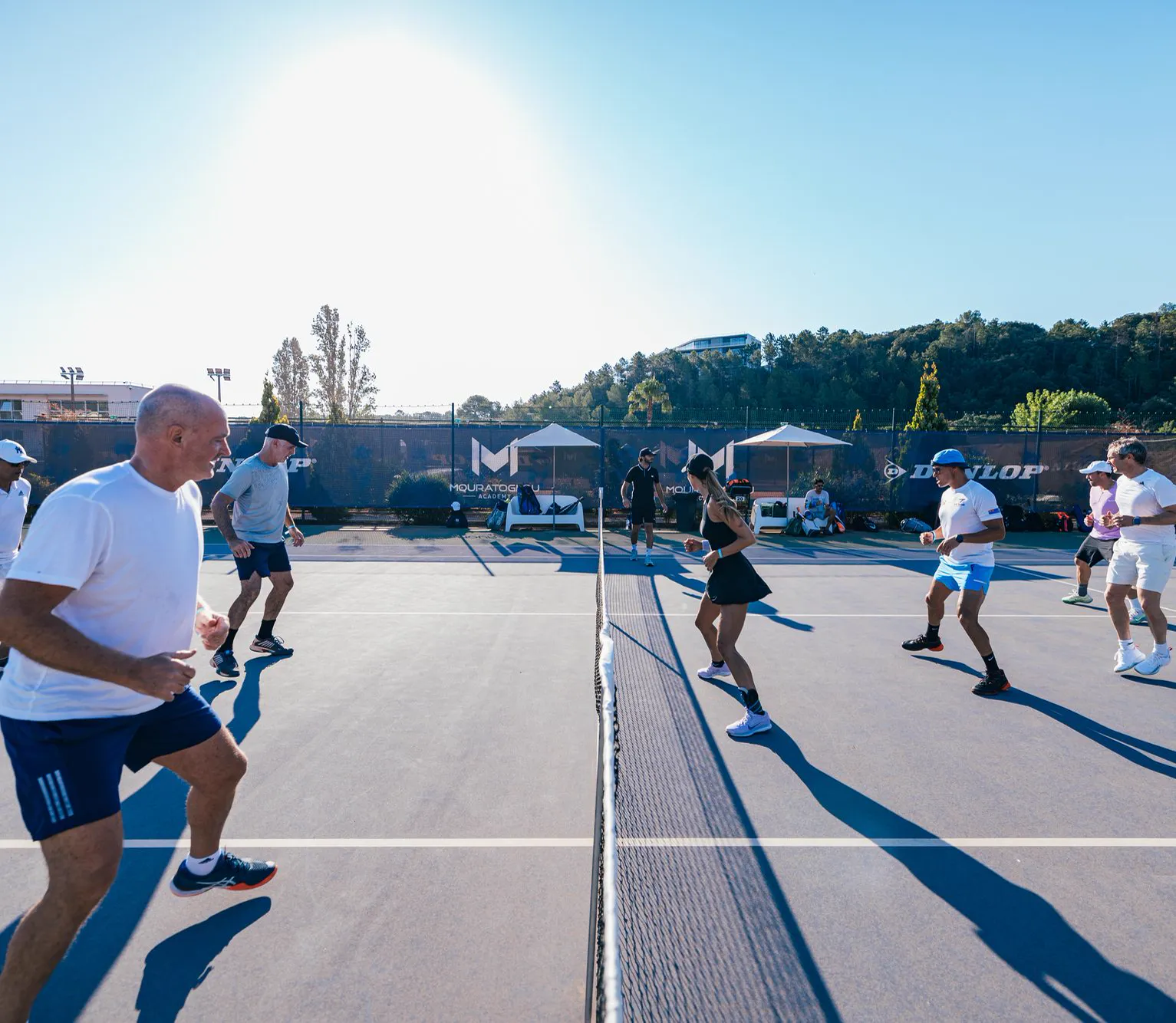
That is why side steps also make an excellent warm-up exercise: they gradually activate the leg and trunk muscles, improve lateral mobility and prepare you for the changes of direction in a match. Build them into your pre-match routine.
3 drills to practise side steps
- Tramline shuffle: side-step back and forth across the doubles alley, knees bent, touching each line with your hand. 4 sets of 20 seconds.
- Side step and hit: the coach feeds balls alternately 2 m to your left and 2 m to your right; you move only with side steps, then recover to the middle.
- Mirror drill: facing a partner, follow their lateral movements with side steps, staying directly opposite them. Excellent for reactions.
At our camps, movement is part of every session, from the warm-up to ball drills. That goes for our junior morning camps as well as our adult camps.
Side steps work together with net footwork and the running forehand, where they bring you back to the middle. In the Mouratoglou Method, movement is a pillar of the game, trained every day at the Mouratoglou Academy on the French Riviera (Biot, near Nice).
 AdultsFull daysAll levelsPerformance Camp AdultA week of intensive tennis, 4 players per coach: technique, match play, physical and mental training.DISCOVER
 Frequently asked questions
What is the difference between a side step and a crossover step?
In a side step, the feet come together without ever crossing and the body stays facing the net. In a crossover step, one leg passes in front of or behind the other to cover more distance. The first is for short moves and adjustments, the second for long distances.
Should you side-step at the net?
Yes. At the net, movements are short and you need to stay facing the play: side steps let you shift quickly towards the ball while staying ready to volley. For a ball further away, a final crossover step helps you reach it.
Are side steps useful for warming up?
Yes, they are a classic: they activate the calves, thighs, glutes and core, and prepare the joints for changes of direction. A few lengths along the net or the baseline are enough before you start hitting.
How many side steps should I take to recover?
There is no fixed number: two to four side steps are usually enough after a moderately wide ball, while a very wide ball calls for a crossover step first, then side steps. The goal is to be balanced and facing the net when your opponent strikes. The split step marks the end of your recovery.
How are side steps trained at a tennis camp?
Coaches build them into warm-ups, then into baseline drills with a mandatory recovery to the middle. They are corrected on video: low centre of gravity, feet that never cross, quiet steps. On the Player Camp Junior, these movement routines are part of every session.