Technique · Volley
Footwork at the net: mastering movement on the volley
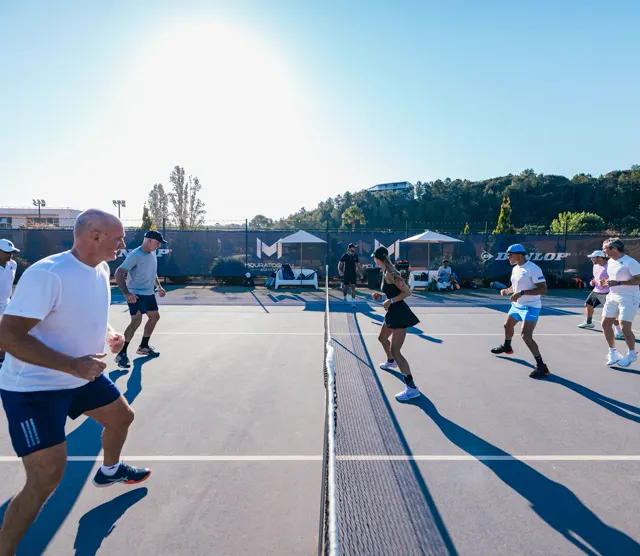
Footwork at the net comes down to three things: a low, active ready position, a split step at the exact moment your opponent hits, then small quick steps forward and diagonally so you volley on balance. At the net, it is your legs that position the racquet and supply the power, not your arm.

Key takeaways
- Ready position: knees bent, weight on the balls of the feet, racquet in front.
- Split step: a small hop as your opponent strikes the ball, so you can move in any direction.
- Small quick steps rather than big strides: they keep you balanced and let you adjust at the last moment.
- Always forward: move diagonally towards the net to meet the ball; do not back off to volley.
- Recovery after every volley, in line with your opponent’s possible angles.
Why is footwork at the net so important?
The net is where everything happens fastest. At the baseline you have time to prepare; at the net you must react in a fraction of a second, get into position and constantly adjust your stance. Without good footwork at the net, you arrive late or hit off balance, and even the best volley technique is no longer enough.
Good net footwork lets you:
- Cover more court and reduce the angles available to your opponent.
- Play every volley on balance, and therefore with more control.
- Take the ball earlier and higher, taking time away from your opponent.
- Link a volley, a second volley and a smash without being wrong-footed.
The fundamentals of footwork at the net
An active ready position
This is the “athletic stance”: knees bent, feet a little wider than shoulder-width, weight on the balls of the feet, racquet in front. The legs stay active, ready to push towards a low volley or a higher ball.
The split step
The most important movement at the net: a small hop on the spot, timed exactly as your opponent hits. You land on the balls of your feet, loaded, just as you read the direction of the ball, and can push off immediately to either side. Too early and you have already landed and frozen; too late and you are still in the air when you need to move.
Small steps and the crossover step towards the ball
For balls close to you, small quick steps are enough. For a wider ball, push off the opposite leg and take a crossover step forward, diagonally towards the net: that step puts your weight into the volley. See our article on the crossover step.
Recovery
After each volley, recover quickly with side steps, in line with the ball you have just played, to cover the angles of your opponent’s reply.
How to approach the net: the movement sequence
- Attack: a deep approach shot or a serve and volley gives you time to come in.
- Move in fast while your opponent has not yet hit.
- Split step as they strike, wherever you are (often around the service line).
- First volley: played moving forward, often low, aiming deep.
- Keep moving in and split step again: the second volley is played closer to the net and higher, to finish the point.

Three drills to improve your footwork at the net
1. Split step timing
With a partner or coach, split step before every practice ball, focusing on the exact timing of the hop: you should land as the other player makes contact.
2. Lateral movement along the net
Move quickly from one side of the service box to the other, knees bent, racquet in front, staying ready to play a volley at any moment. 3 sets of 30 seconds.
3. Volleys on the move
The coach feeds balls slightly to either side: split step, crossover step forward, volley, recover. This drill links your legs directly to the volley, on the forehand and the backhand volley.

Net movement mistakes to avoid
| Mistake | Consequence | Fix |
|---|---|---|
| No split step | Late start, late volley | A hop on every opponent’s shot |
| Big strides | Off balance, unable to adjust | Small quick steps |
| Backing off to volley | Weightless volley, short ball | Move diagonally forward to the ball |
| Leaning back at contact | Loss of power and control | Weight slightly forward |
| Standing still after the volley | Open angles for your opponent | Immediate recovery with side steps |
 AdultsFull daysAll levelsPerformance Camp AdultA week of intensive tennis, 4 players per coach: technique, match play, physical and mental training.DISCOVER
 How do you measure your progress at the net?
Set simple markers: number of volleys played in front of the service line, number of split steps timed with the opponent’s contact, number of overheads made after a lob. Film a few points from behind the baseline: you will see at once whether you freeze or keep moving forward. The same footwork serves the backhand volley and serve and volley, where the first step after the serve often decides the point.
At the Mouratoglou Academy on the French Riviera (Biot, near Nice), net play is trained in match situations, following the Mouratoglou Method.
Frequently asked questions
How can I get quicker at the net?
Work on your split step timing and short lateral movements. The more automatic they become, the faster you react. Reading your opponent also buys valuable time.
Should I take big steps at the net?
No. Small quick steps keep you balanced and let you adjust until the last moment. The only useful big step is the crossover step forward when volleying a wide ball.
When should I split step?
Exactly as your opponent hits the ball, so you land on the balls of your feet just as you read the direction. Too early or too late and it loses its effect.
How do I stay balanced on the volley?
Start from a low stance, split step on every opponent’s shot and move with small steps, weight slightly forward. Avoid backing off or leaning back at contact.
What drill can I do alone to improve my net footwork?
Place four cones around the volley zone and touch them in a random order called by a partner or an app, returning to the ready position between each one. Three 30-second sets are enough. On the Performance Camp Adult, this drill comes before volley sessions to wake up the footwork.