Technique · Power
Effortless power in tennis: how to hit harder without forcing
To hit harder in tennis, you do not need to squeeze harder: you need to swing the racquet faster. Power starts in the legs, flows through the rotation of the trunk and is released through a relaxed arm. Players who “muscle” the ball lose both speed and control. Here is how to turn that logic around.
Key takeaways
- Power = racquet-head speed at contact, not arm strength.
- Relaxation comes first: a tight grip slows the swing and strains the arm.
- Legs and trunk create the energy; the arm only transmits it (the kinetic chain).
- Your weight moves forward through contact, towards the target.
- Control first: raise the pace step by step without giving up consistency.
Where does power in tennis really come from?
Ball speed depends mostly on racquet-head speed at impact and on hitting the sweet spot. A player who squeezes the handle and pushes with the shoulder produces a slow swing, even if it feels like a lot of effort. A fluid, relaxed swing, on the other hand, lets the racquet “whip” through the ball, which is exactly what you see in every professional player.
That whip comes from the kinetic chain: energy starts from the ground and travels through the legs, hips, trunk, shoulder, elbow and wrist. Each segment speeds up the next one, as long as no link is locked. That is why relaxation is the first key to power, even before technique.
The 4 keys to hitting harder without forcing
In his power masterclass, Patrick Mouratoglou comes back to one simple idea: chase speed, not effort. These are the four levers our coaches work on first.
1. A relaxed arm and hand
A loose arm accelerates faster than a tense one. Breathe out as you hit, keep your shoulders down and your wrist supple. The swing should finish freely over the opposite shoulder.
2. Legs and footwork
Bend your knees during the backswing, then drive up and forward from the ground. Good spacing (not too close, not too far from the ball) lets you make contact in front of your body, where the racquet reaches its top speed.
3. Trunk rotation
Turn your shoulders on the take-back, then uncoil the hips and trunk into the ball. That rotation is the engine of the forehand and of the two-handed backhand. Without it, the arm has to do all the work.
4. Weight transfer
Through contact, your weight shifts from the back leg to the front leg, towards the target. A player who falls backwards while hitting wastes most of the energy. For attacking situations, see our guide to the attacking forehand.
Power and control: finding the right balance
Hitting hard is pointless if the ball lands out. The right setting combines pace with topspin: spin makes the ball dip, so you can swing faster while keeping clearance over the net. Power and spin are not opposites, they work together, as we explain in power vs spin.
Your forehand grip matters too: a semi-western grip makes it easier to brush up and accelerate safely, while a very closed grip on a low ball limits the speed you can actually use.
Drills to build power
- Relaxed shadow swings: 3 sets of 10 swings without a ball, listening for the “whoosh” of the racquet. The sharper the sound, the faster the racquet head.
- 50, 70, 90 % hitting: on one basket, alternate three speeds with the same swing. You learn that pace comes from relaxation, not tension.
- Medicine-ball throws: side-on, throw a 2–3 kg ball against a wall by turning the hips, then the shoulders. It is the best way to feel the kinetic chain.
- Hitting on the move forward: the coach feeds a short ball and you strike it while stepping into the court, weight on the front leg.
- Deep target: aim between the service line and the baseline. Depth is often worth more than raw speed.
The mistakes that rob you of power
- Gripping too tight, too early: the arm locks and the swing slows down.
- Late contact, with the ball level with your body: the racquet has no time to accelerate.
- Staying on your heels: with no leg drive, all the power comes from the shoulder, which risks injury.
- Cutting the follow-through to “control” the ball: you lose speed and, paradoxically, accuracy.
- Going for a winner on every ball: power is built on consistency.
These faults are hard to see on your own. At camp, our coaches film your strokes and break them down using the Mouratoglou Method, which starts from your build and playing style rather than one “perfect” swing.
Build your power at camp on the French Riviera
At the Mouratoglou Academy in Biot, on the French Riviera, power is trained both on court and in the gym: footwork, core stability, rotation and speed. Adults develop it during the Performance Camp Adult (4 players per coach), juniors during the Performance Camp Junior. Compare every option on our tennis camps page and book your camp in a few clicks.
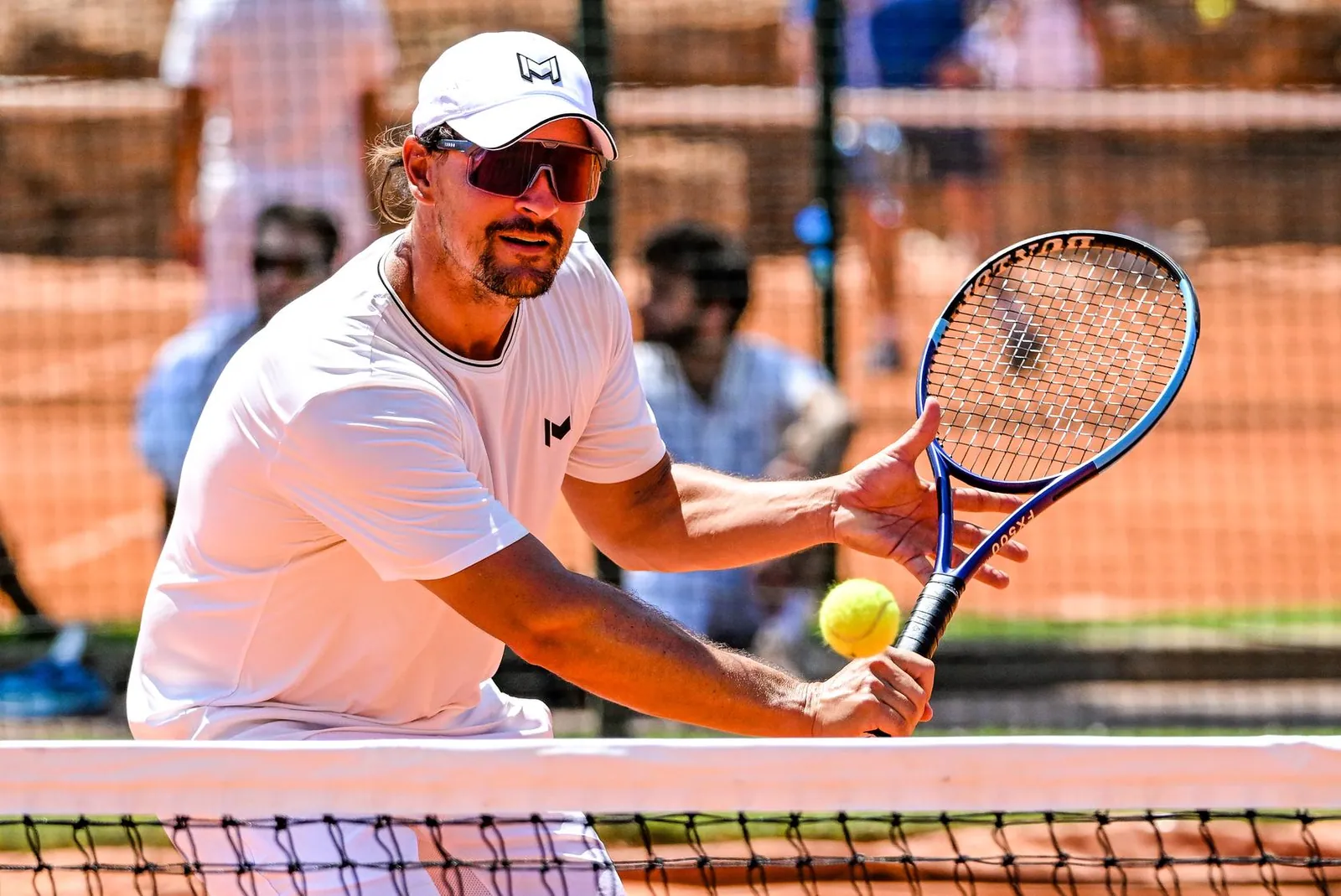 AdultsFull daysAll levelsPerformance Camp AdultA week of intensive tennis, 4 players per coach: technique, match play, physical and mental training.DISCOVER
 Frequently asked questions
How can I hit harder in tennis without losing control?
Increase racquet-head speed while staying relaxed, and add topspin: spin brings the ball down and gives you margin over the net. Build up in steps (70 %, then 80 %) without changing your swing.
Does power come from the arm?
Very little. It comes from the legs and trunk rotation; the arm passes the energy on. An arm that forces slows the kinetic chain and tires the elbow and shoulder.
Do I need weight training to hit harder?
Core, leg and rotational work (medicine ball) helps a lot. But technique and relaxation bring the fastest gains, especially for club players.
Which racquet gives more power?
A slightly larger head, a stiffer frame and a slightly lower string tension give “free” power. But no equipment replaces a relaxed swing.
Why does the ball fly long when I hit hard?
Usually because the pace comes without spin, or because contact is late. Look for contact in front of you and a low-to-high swing to add topspin.