Technique · Spin
Power vs spin: how topspin really works in tennis
Topspin is the spin that makes the ball rotate forwards: it clears the net high, dives into the court and kicks up after the bounce. Power and spin are not opposites: both depend on racquet-head speed, but not on its direction. Swing forwards and you create ball speed; swing upwards and you create rotation. The art lies in balancing the two.
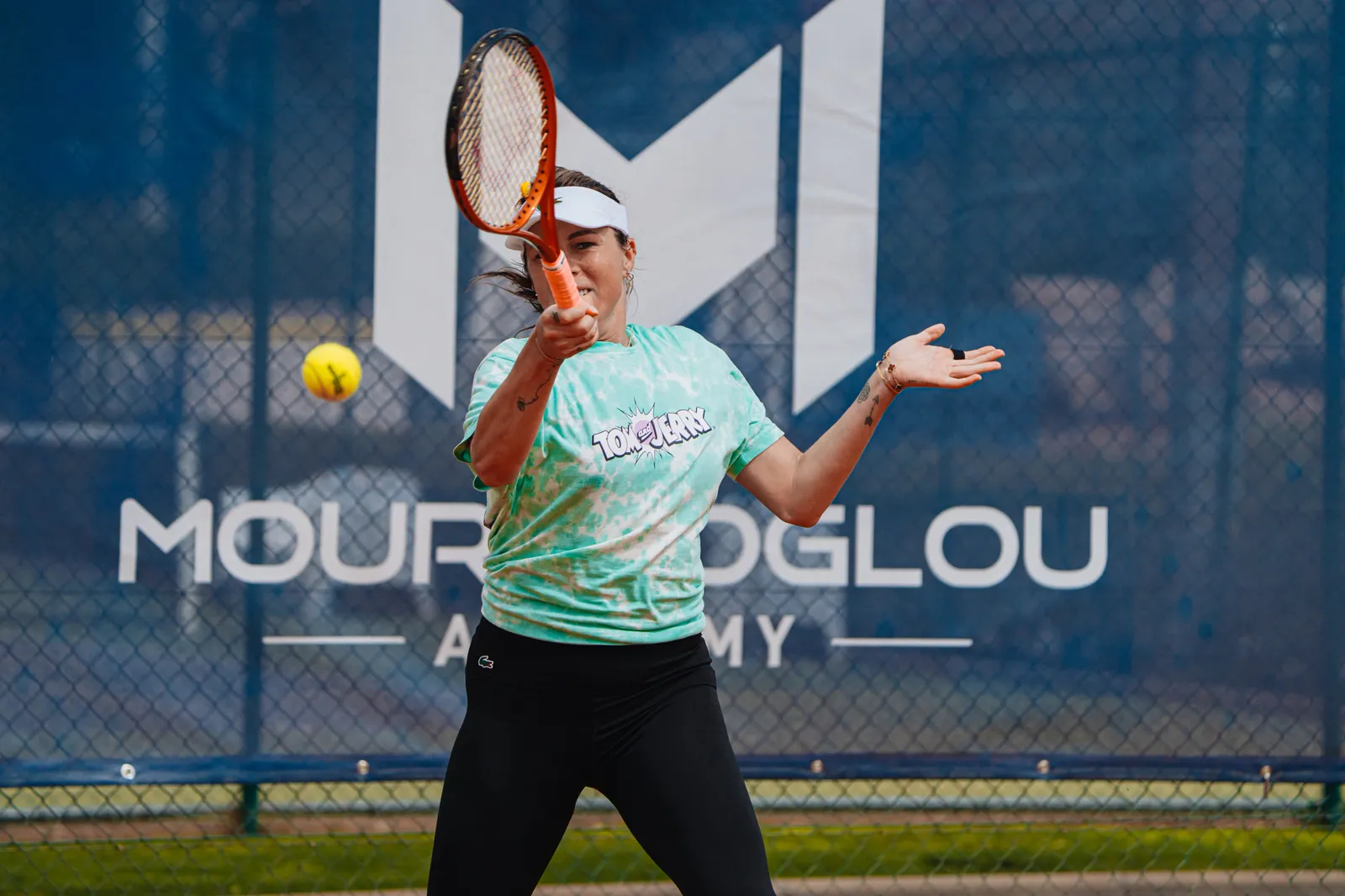
Key takeaways
- Same engine, two directions: racquet speed going forward gives power, going up gives topspin.
- Topspin creates margin: the ball clears the net higher and still lands in the court.
- Brushing: the racquet starts below the ball and rises, face almost perpendicular to the ground.
- Grip matters: semi-western or western make topspin easier; continental limits it.
- Adjust to the situation: more spin in defence and construction, more pace to finish the point.
Power and spin: what is the difference?
When the racquet meets the ball, its energy splits in two: part of it drives the ball forward (speed), the rest makes it spin. A horizontal swing path, face towards the target, produces a fast, flat ball. A very steep upward path produces a ball that spins a lot but travels less. Every player finds their own setting in between.
That is the core idea of Patrick Mouratoglou’s video on power and spin: you do not choose one against the other, you decide the direction of your acceleration. A player who hits hard and flat must aim just over the net; a player who uses topspin can accelerate with a large margin for error.
Why topspin has become essential
- Safety: the ball can clear the net by a metre and still drop into the court thanks to the Magnus effect.
- High bounce: your opponent has to hit above the shoulder, an uncomfortable zone, especially on the backhand.
- Angles: topspin lets you play short crosscourt balls that pull the opponent off the court.
- Consistency: you can accelerate without risking errors, so you can stay in the rally longer.
Equipment has reinforced the trend: polyester strings bite the ball more and make rotation easier. Almost every professional now uses a topspin forehand as their base shot.
How to hit topspin: the technique
1. The grip
A semi-western grip is the best compromise for most players: it closes the face slightly and lets you get under the ball. A western grip gives even more spin but makes low balls harder.
2. The loop and the drop below the ball
After the take-back, the racquet head drops below the level of the ball, about 30 to 40 cm. That low point is what allows you to swing up. A racquet that stays at ball height produces a flat shot.
3. Brushing
At contact, the face stays almost vertical and the racquet rises quickly: the strings “brush” the back of the ball from low to high. The wrist stays supple and the forearm rotates (pronation) to speed up the racquet head.
4. The follow-through
The swing finishes high, over the opposite shoulder, or as a “windshield wiper” at hip level for heavy topspin. The more spin you want, the more the swing rises.
Balancing power and spin by situation
| Situation | Setting | Goal |
|---|---|---|
| Defence, difficult ball | Lots of spin, high trajectory | Buy time, avoid errors |
| Building the rally | Medium spin, depth | Push the opponent back |
| Short ball to attack | More pace, less spin | Finish the point |
| Short crosscourt angle | Maximum spin, rising swing | Pull the opponent off the court |
To go further on ball speed itself, read our guide on how to hit harder without forcing.
Common mistakes and corrective drills
- Spinning with the wrist only: the swing breaks and loses speed; topspin must come from the whole arm and the legs.
- Opening the face at contact: the ball climbs too much and flies long.
- No low point: the racquet never drops below the ball, so the shot stays flat.
- Late contact: without contact in front, you cannot brush properly.
- Topspin mini-tennis: short rallies, balls that clear the net high and dive into the box.
- Target + height: a rope stretched 1 m above the net; every ball must clear it and land beyond the service line.
- 3-3 variation: three heavy-topspin balls, three faster balls, same basic swing.
Master topspin at camp on the French Riviera
Balancing pace and spin is part of our coaches’ daily work, following the Mouratoglou Method. At the Mouratoglou Academy in Biot, on the French Riviera, adults train it during the Performance Camp Adult and juniors during the Performance Camp Junior, with video analysis and match situations. Compare our tennis camps and book online.
 Ages 9–17Full daysBoarding optionPerformance Camp JuniorThe intensive camp for young players: technique, tactics, fitness and mindset, 4 players per coach.DISCOVER
 Frequently asked questions
How do I put topspin on the ball?
Drop the racquet below the ball, then swing up quickly through contact with an almost vertical face. Finish high, over the opposite shoulder.
Does topspin cost power?
A little ball speed, yes, but it lets you swing much faster without errors. In the end, a player who uses topspin can hit harder safely.
Which grip is best for topspin?
The semi-western is the most versatile. The western gives more spin but makes low balls harder. The continental is poorly suited to topspin.
Which strings give more spin?
A polyester monofilament, possibly with a shaped profile, grips the ball better. It is stiffer, so avoid it if you have arm pain.
Should I hit topspin on the backhand too?
Yes, the topspin backhand, one- or two-handed, is the basis of baseline play. The slice complements it for variety and defence.