Tactics · Return
Tactics for returning serve in tennis
Return of serve tactics depend first on the quality of the serve. Against a good first serve, you look for margin: a deep return through the middle or cross-court, where the server has the least angle. Against a second serve, you take the initiative: a more aggressive return, often deep cross-court or behind the server’s recovery. Against a serve-and-volleyer, you aim low, at their feet.
Key takeaways
- Good first serve: depth through the middle comes first; it is the safest target and takes away the server’s angles.
- Pulled wide: the long diagonal offers the greatest distance and therefore the greatest margin.
- Serve into the body: clear space, shorten the swing and hit firmly through the middle with plenty of margin.
- Second serve: step into the court and attack, especially behind the server’s recovery.
- Against serve and volley: return low at their feet; the first passing shot need not be perfect.
What are the principles of return of serve tactics?
On the return you are on the receiving end of the first strike, so tactics are about finding the best balance between risk and pressure. Three principles guide that choice:
- Distance gives margin: a cross-court return travels further than one down the line and crosses the lowest part of the net.
- The middle neutralises: a deep return through the centre gives the server no angle for their second shot.
- The server lands moving one way: after serving, they land inside the court, slightly towards their hitting side. Playing against that movement wrong-foots them.
These choices assume a solid return stroke (split-step, short backswing, contact in front), covered in our article on return of serve technique.
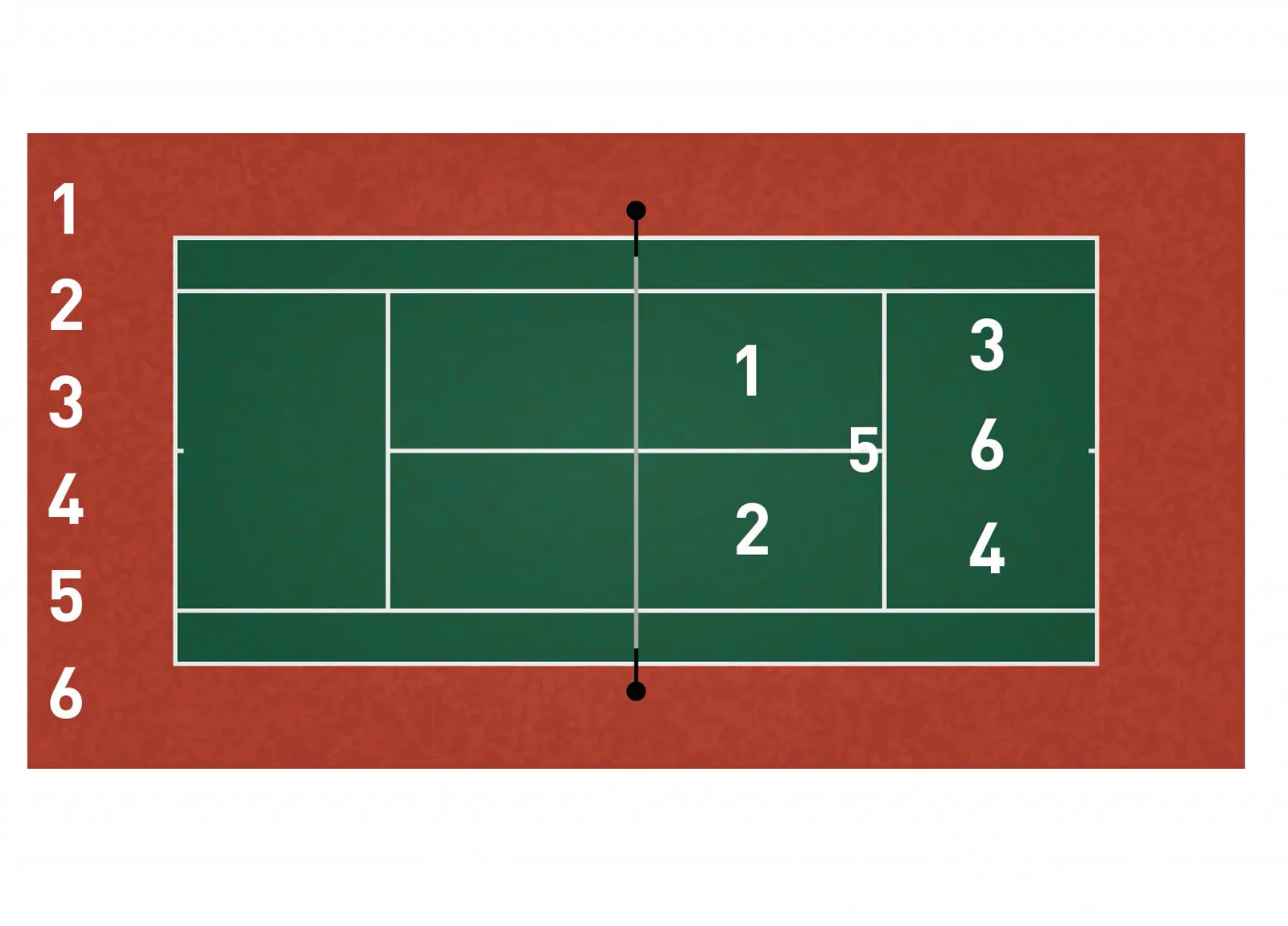
The target zones on the court
| Zone | Where | When to aim there |
|---|---|---|
| Deep middle (6) | Near the baseline, centre | Good first serve: neutralise |
| Deep corners (3 and 4) | Baseline corners | Average or second serve: take the initiative |
| Short angles (1 and 2) | Near the sidelines, inside the service line | To pull the server wide, or as a chip against a very tough serve |
| Short middle (5) | In front of the service line, at the feet | Against a server coming to the net |
Where should you return a first serve?
The serve pulls you wide
Against a good first serve that pulls you out of the court, favour the long diagonal: the ball has further to travel, so more margin, and it moves away from a server landing the other way. If the serve is really fast, shorten your backswing and counter using the ball’s pace, at medium height. A deep return through the middle remains the safe option to pin the server down.
If the serve is excellent and you are stretched, a right-hander can let go with the left hand on the backhand to gain reach. Then look for a short, low cross-court ball that forces an awkward shot, or failing that, a high, deep ball.
The serve comes into the body
There is almost no angle: the best answer is nearly always a deep return through the middle, at the feet of a server moving into the court. If you have to clear space, the backhand side is often easier, as it is more natural to hit a ball close to the body on the backhand.
The serve goes down the T
The ball arrives fast and your contact point is not far forward, so going cross-court is difficult. Aim instead down the line to the deep corner, away from the server’s recovery, or deep through the middle if the serve is very good.
How do you attack a second serve?
On second serves the server takes fewer risks: it is your turn to take the initiative. Step in a pace or two and commit your body forwards; aggressive intent is not enough if you hit while backing off.
- Wide serve: a firm return between the long diagonal and the middle, or chip and charge cross-court so you have less ground to cover to the net.
- Body serve: hit hard through the middle with generous margin, following it in or not.
- Serve down the T: an inside-out return behind the server’s recovery can end the point; to come in, prefer cross-court, which leaves you less exposed to the passing shot down the line.
- Serve to your forehand: often your best shot, so use it to pull the server wide; to come in, favour the middle.
Against a kick second serve that bounces high, take the ball on the rise to keep your angles. Against a slice second serve that stays low, go for depth instead. A firm inside-out or cross-court backhand is a valuable weapon in these situations.
 Ages 9–172 weeksCoached tournamentsTournament Camp JuniorTwo weeks of training and tournaments, with a coach by your side during matches.DISCOVER
 What should you do against a server who comes to the net?
Against serve and volley, move closer to your baseline and aim for a low return at the feet, in front of the service line. The server is still far from the net and has to play a difficult low volley, so your first passing shot does not need to be perfect. Short angled returns also work if the serve is not too hard. Avoid going for length, which gives the volleyer a ball at the ideal height.
How do you build your return plan during a match?
- Watch the first few games: where does the server go on big points? What spin on the second serve?
- Adjust your position: back off against a big serve, step in against a weak second serve.
- Choose one target per point before the server tosses the ball, and stick to it.
- Mix it up: a predictable returner lets the server prepare their second shot.
The return fits into a wider game plan, which we cover in our guide to tennis tactics and our article on baseline tactics. In competition, these patterns are practised in real match situations: that is the heart of our Tournament Camp Junior.
At the Mouratoglou Academy on the French Riviera (Biot, near Nice), the return plan is built with the coach to suit the player’s profile: the Mouratoglou Method individualises tactics just like technique. Daniil Medvedev is a good example of the very deep return position against big servers. For pure technique, see our article on return of serve technique and the principles of tennis tactics. More about our camps.
Frequently asked questions
Should you return cross-court or down the line?
Against a difficult first serve, cross-court or through the middle, as they offer more margin: the ball travels further and crosses the lowest part of the net. Down the line is better kept for second serves, or for wrong-footing the server when you are well set.
Where should you stand to return a big serve?
One or two steps behind the baseline, on the bisector of the server’s possible angles. Standing back gives you a little more time but widens the server’s angles, so compensate with a well-timed split-step and a short swing.
How do you return a kick second serve?
Step in and take the ball on the rise, before it gets above your shoulder. You gain time and angles. If you prefer to move back, commit to it, so you hit the ball on its way down at a comfortable height.
What is chip and charge?
Coming to the net straight after the return of serve, mainly against a weak second serve. You usually play a cross-court or central return, which shortens your path to the net and reduces the opponent’s passing angles.
How do you prepare your return plan before a match?
Watch your opponent’s warm-up: their favourite serve, their second serve, whether they come in. Set a default starting position and target for each side, then adjust after two or three games. Note what works. In the Tournament Camp Junior, the coach prepares and debriefs this plan with the player.