Technique · Practice
Tennis drills: exercises to improve at every session
A good tennis drill has a clear goal, a simple rule and a score. That is what sets it apart from random hitting. Here are ten drills our coaches use every day, from the simplest to the most demanding, to practise with a partner, with a basket or alone against a wall. Some look basic: they are often the most effective.
Key takeaways
- One goal per drill: consistency, depth, movement or finishing.
- Always keep score: a score turns a drill into a challenge and measures progress.
- Simple drills pay off most: mini-tennis, targets, crosscourt rallies.
- Footwork can be trained too: split-step and recovery on every ball.
- On your own, the wall is still a great partner for consistency and timing.
What makes a good tennis drill
Many players “hit balls” for an hour with no goal. They sweat, but they barely improve. An effective drill sets a constraint (a zone, a number of balls, a type of shot) and a success criterion. It also moves gradually closer to match play: start cooperatively, then add opposition.
That is the logic we describe in our guide on improving your technique: one focus at a time, repeated in conditions closer and closer to real play.
Consistency and depth drills
1. Mini-tennis
Controlled rallies inside the service boxes. The best players start almost every session this way: it is a deceptively simple drill that tunes timing, touch and positioning. Goal: 30 rallies without a miss.
2. Crosscourt rallies
Forehand crosscourt against forehand crosscourt, then backhand against backhand. Aim for the half of the court marked by the centre line. Score: first to 21 consecutive shots.
3. The depth zone
A line of cones 2 m inside the baseline. A ball that lands short is a point lost. This drill transforms your ball quality, because depth often hurts more than speed.
Footwork drills
4. The butterfly
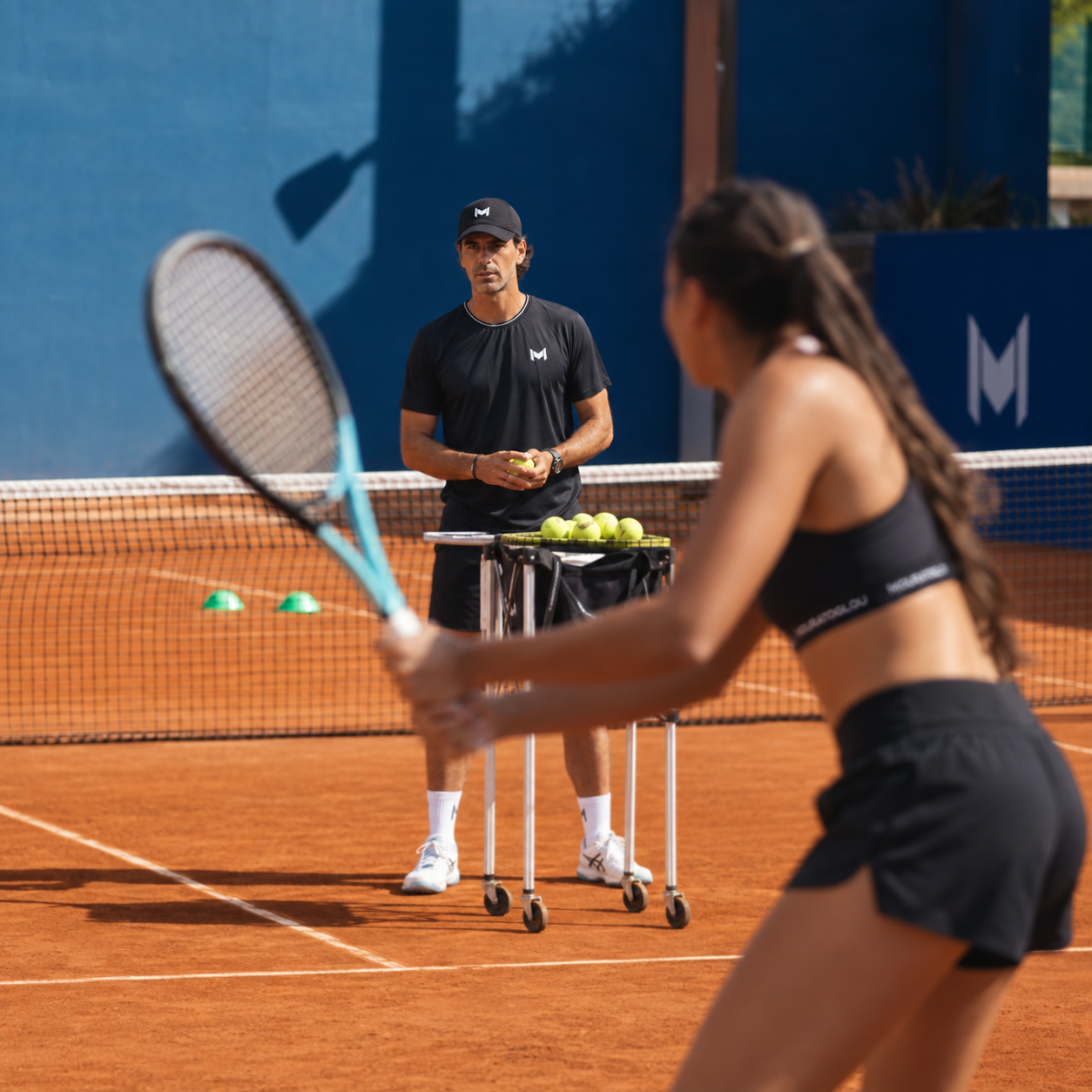
The coach feeds alternately to the forehand and the backhand. After each shot, the player recovers to the middle and split-steps. Goal: 10 balls per set, 4 sets, with recovery quality first.
5. Short-deep
A short ball to attack moving forward, then a deep ball that forces you back. You learn to adjust your footwork and contact height. For movement technique, see our article on baseline footwork.
Serve, return and net drills
6. Serving at targets
Three targets per box (wide, body, T). Ten serves per target, counting the hits. Variation: play first and second serves in sequence, as in a match.
7. Serve + first shot
After the return, the server must play their first shot into a defined zone (often an inside-out forehand). This is the drill that links the serve to the rally.
8. Continuous volleys
Two players at the net, one on each side, volley without letting the ball bounce. Reflexes, continental grip and a short swing guaranteed.
9. Themed play
A set where points only count if you win them a certain way (at the net, after a crosscourt forehand…). It forces you to apply a plan, as in our articles on baseline tactics.
Solo tennis drill: the wall
10. The wall
The wall never misses: it is the ideal partner for consistency. Draw a line at net height (91 cm / 3 ft) and alternate:
- Forehands only, then backhands only, counting consecutive hits.
- Forehand / backhand alternation to work on grip changes.
- Volleys close to the wall for reflexes.
- Serves at a drawn target, for the toss and accuracy.
Without a wall, you can still work on your toss, shadow swings and fitness at home.
To build a full session, chain three or four of these drills: a consistency drill to warm up, a technical drill aimed at your weakness, a footwork drill, then themed play or a set. Write your scores in a notebook: within a few weeks you will see exactly where you are improving and what still needs work.
Structured sessions at camp on the French Riviera
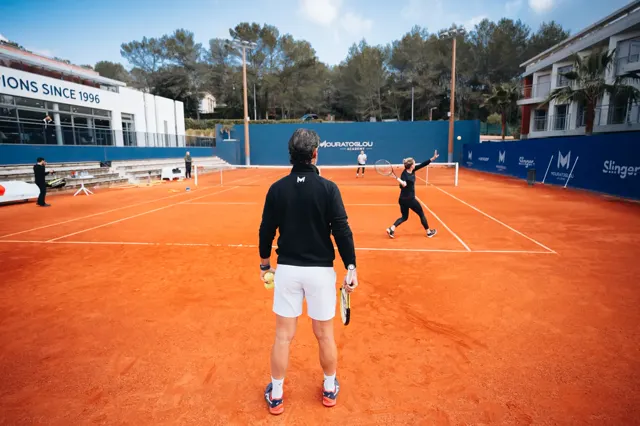
At camp, every session follows a progression built by the coach: warm-up, targeted technical work, game situations and matches. That is how the Mouratoglou Method works at the Mouratoglou Academy in Biot, on the French Riviera. Adults enjoy coached tennis mornings at the Player Camp Adult, juniors at the Player Camp Junior. Compare our tennis camps and book online.
 AdultsMorningsAll levelsPlayer Camp AdultCoached tennis mornings to progress at your own pace, with afternoons free on the French Riviera.DISCOVER
 Frequently asked questions
What is the best tennis drill to improve?
Mini-tennis and crosscourt rallies with a consistency target pay off the most. They improve timing, control and confidence.
How can I practise tennis on my own?
Against a wall with a line at net height, alternating forehands, backhands, volleys and serves. Shadow swings and toss practice also work solo.
How long should a drill last?
Usually 10 to 15 minutes. Beyond that, focus drops. It is better to chain three or four short drills with a clear goal.
Should I always keep score in practice?
Yes, as often as possible. A score creates engagement and lets you measure progress from one session to the next.
Which drills improve footwork?
The butterfly, short-deep and sets with a split-step and recovery to the middle are the most useful. An agility ladder complements the work off court.