Preparation · Fitness
Tennis coordination exercises: move better on court
Coordination is the ability to link precise movements by making several parts of the body work together at the right moment. In tennis, you train it with varied, playful exercises: racquet juggling, agility ladder, ball games, balance work. A few minutes in each session is enough to improve, at any age.
Key takeaways
- Definition: coordination organises the body’s movements in space and time to produce an efficient stroke.
- 5 types used in tennis: hand-eye, spatial, temporal (rhythm), upper/lower body dissociation, balance.
- Variety comes first: changing rhythms, balls, footwork and instructions stimulates more than repeating one drill.
- Key age: roughly between 5 and 12, children learn motor skills especially quickly.
- Indirect benefit: better coordination makes strokes more economical and helps prevent injuries.
Why do coordination exercises for tennis?
Coordination lets you link precise movements and activate several muscle groups at once, at the right moment. It is what allows the other physical qualities to express themselves: strength, speed or endurance are useless if they are not applied in the right place at the right time.
In tennis, every shot requires reading a trajectory, moving, balancing, rotating the trunk and hitting, all in one or two seconds. Coordination exercises make these sequences smoother, more accurate and more economical. Less wasted effort also means less strain on the joints (see preventing tennis injuries).
Which types of coordination should you train?
| Type | Definition | On court |
|---|---|---|
| Hand-eye | Adjusting the hand’s movement to what you see | Hitting the ball in the centre of the strings |
| Spatial | Locating yourself relative to the net, lines and opponent | Getting the right distance from the ball |
| Temporal (rhythm) | Adjusting the speed and timing of your actions | Split-stepping as the opponent hits |
| Dissociation | Moving the upper and lower body differently | Running sideways while preparing the racquet |
| Balance | Keeping or regaining stability | Hitting on the run and then recovering |
8 coordination exercises for tennis
Do them at the start of a session, after a warm-up, for 10 to 15 minutes in total. Combine 3 or 4 exercises and vary them from one session to the next.
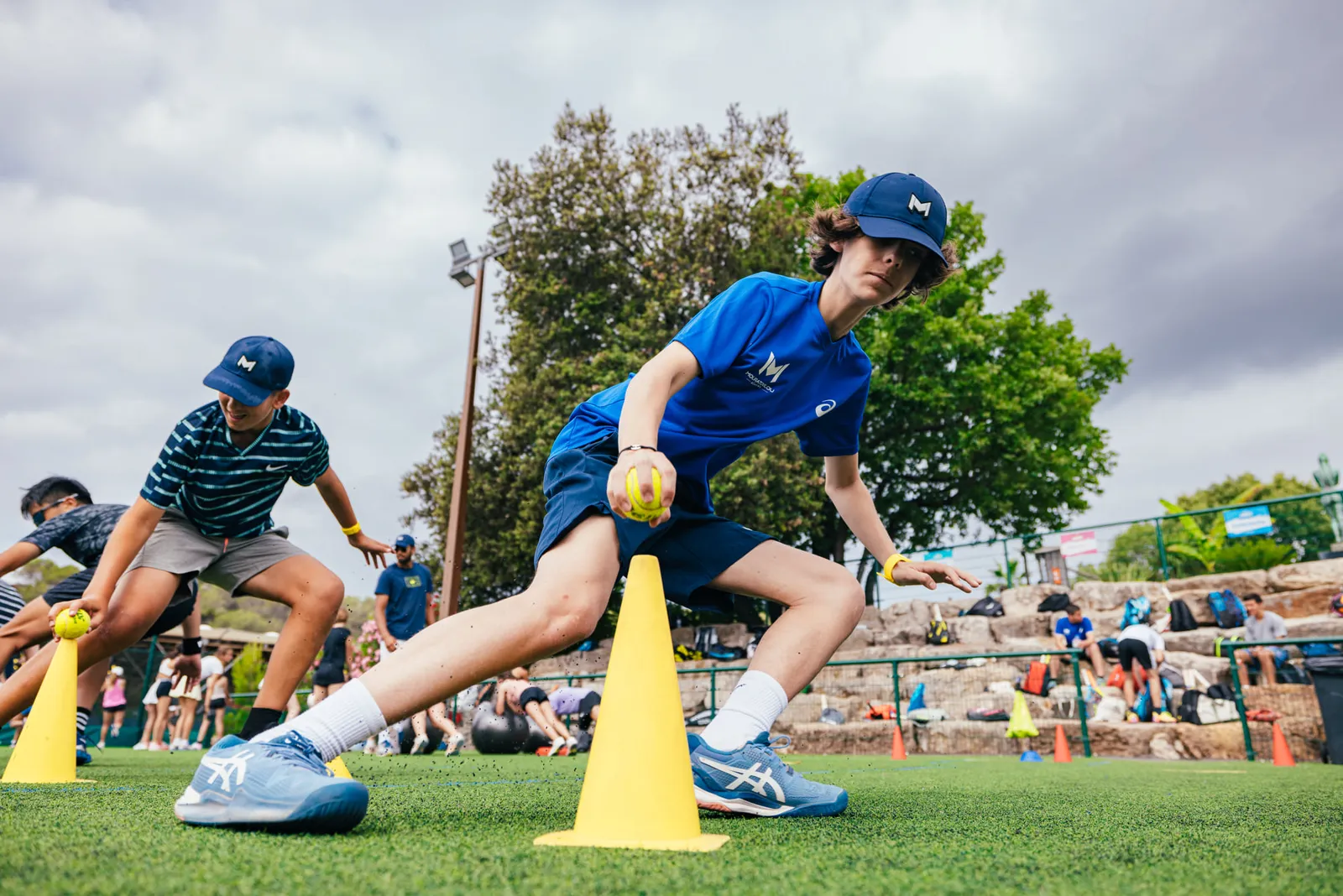
- Racquet juggling: bounce the ball on the strings, alternating forehand and backhand faces, then while walking. Goal: 20 bounces without a miss.
- Cross-catch: throw a ball with one hand and catch it with the other, then with two balls. Add a side step between throws.
- Agility ladder: quick steps in each square (one foot, two feet, lateral steps), keeping the trunk upright and eyes forward.
- Drop-and-catch reaction: a partner holds two balls at shoulder height and drops one; catch it after one bounce.
- Set-rhythm running: run while varying the distance between steps (hoops or cones spaced irregularly).
- Dissociation: while side-stepping, make arm circles or pass a ball from hand to hand behind your back.
- One-leg balance: hold 30 seconds on one leg, then while shadowing a forehand, then with your eyes closed.
- Constrained mini-tennis: rally using only backhands, or tap the ball once on your own strings before sending it back.
How does coordination link with other physical qualities?
- Strength: plyometrics (jumps) and proprioception work on small equipment teach you to use strength at the right moment.
- Speed: starts on a signal, changes of direction and visual reactions combine speed and coordination.
- Endurance: a good aerobic base keeps your movements coordinated when fatigue arrives. See our article on MAS training for tennis.
- Relaxation: a coordinated stroke has no needless tension. See our relaxation exercises.
What role does flexibility play?
Flexibility improves the range of movement and control of technical strokes. There are two kinds of stretching:
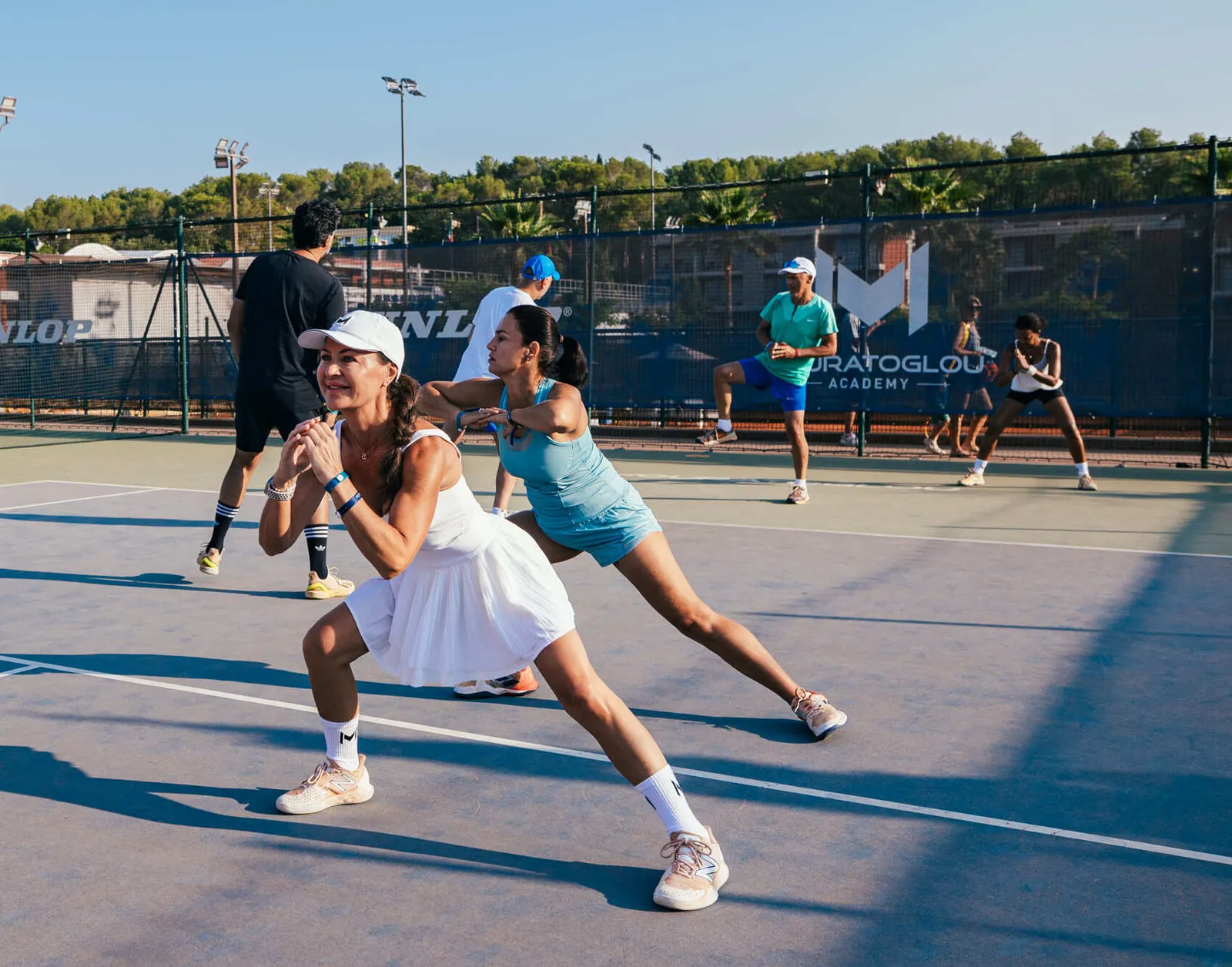
- Dynamic stretching: wide, controlled movements (leg swings, trunk rotations), done before exercise.
- Static stretching: held lengthening positions, rather after exercise or in dedicated sessions, to maintain general flexibility.
At what age should you work on coordination?
At any age, but the period of roughly 5 to 12 is especially favourable: children learn new motor skills very quickly. It is essential to offer them playful, varied activities (ball games, other sports, obstacle courses) alongside tennis, rather than specialising too early.
For the youngest, the Baby Tennis Camp (ages 3–5) develops coordination through play with adapted equipment; from age 6, the Player Camp Junior builds these exercises into its tennis mornings. Adults keep improving their coordination with regular work.
At the Mouratoglou Academy on the French Riviera (Biot, near Nice), coordination is never trained in isolation: in the Mouratoglou Method, every warm-up block feeds directly into the stroke of the day, and the content is individualised to each child’s age and gaps. Our junior camps therefore combine movement-skill stations, baseline footwork and live-ball situations, alongside aerobic speed work for older players. The aim is simple: a body that moves well makes every technical correction easier to absorb.
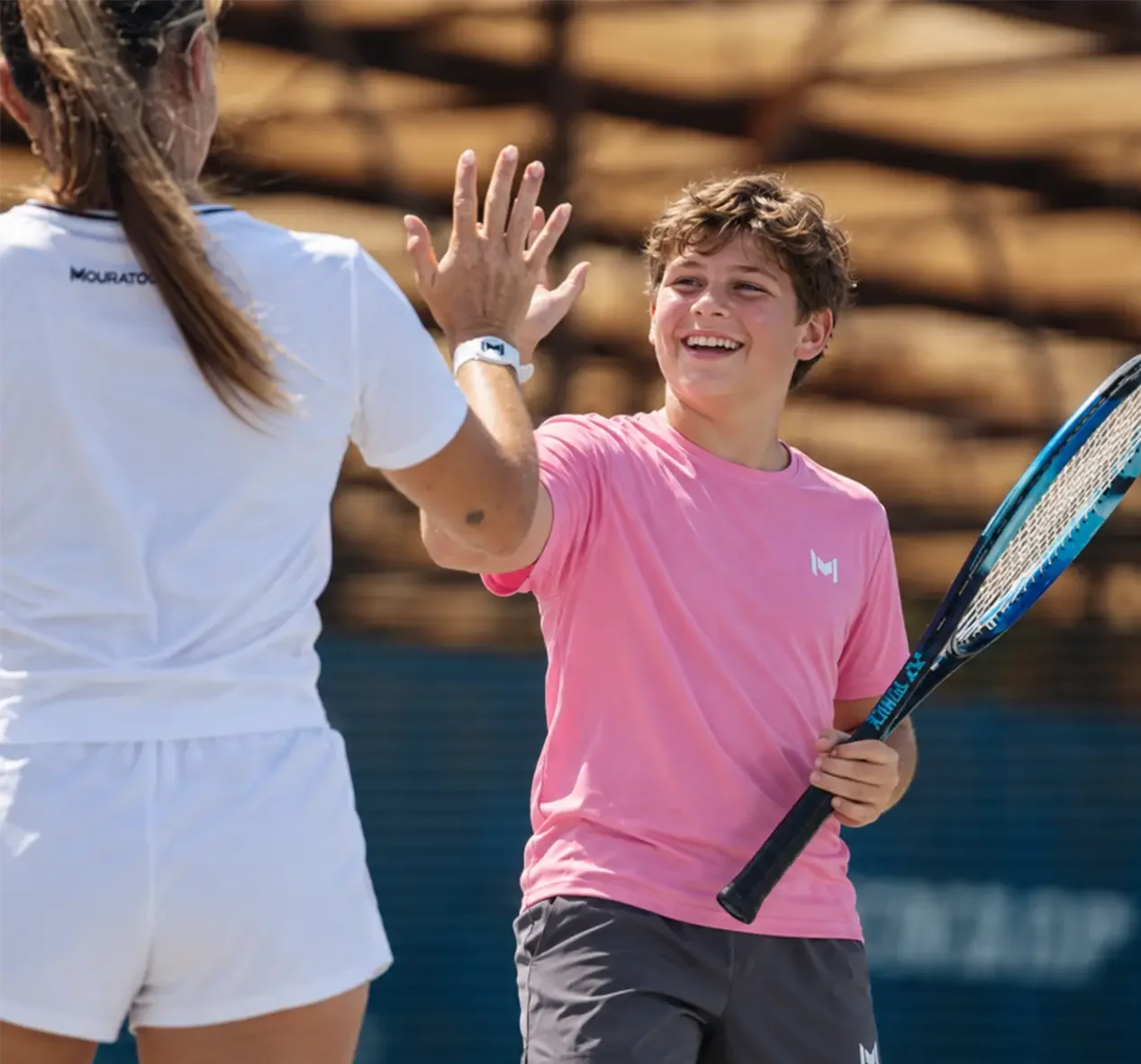 Ages 6–17MorningsAll levelsPlayer Camp JuniorFun and demanding tennis mornings to make progress during the holidays.DISCOVER
 Frequently asked questions
What is the best coordination exercise for tennis?
There is no single one: variety is what drives progress. Racquet juggling, the agility ladder and reaction drills with balls are excellent foundations, to be varied regularly.
How can you improve hand-eye coordination?
With throw-and-catch drills (one hand, two hands, two balls), racquet juggling and slow-paced mini-tennis. A few minutes a day is enough to improve.
Can you train coordination at home?
Yes: juggling against a wall, throw-and-catch, one-leg balance, a ladder drawn on the floor. All you need is a ball, a little space and 10 minutes.
Can an adult still improve their coordination?
Yes. Progress is faster in children, but an adult who regularly practises varied exercises clearly improves the accuracy and fluency of their movements.
How much time should you spend on coordination in each session?
Ten to fifteen minutes is enough, ideally at the start of the session when the nervous system is fresh. Short, varied drills done with quality beat long repetitive sets. With children, coordination can take up a much larger share of the session, in the form of games. In the Player Camp Junior, it is built into every morning of training.