Technique · Backhand
One-handed vs two-handed backhand: which should you choose?
The two-handed backhand dominates today’s game, but the one-hander has not disappeared: Stan Wawrinka, Dominic Thiem and Stefanos Tsitsipas have turned it into a weapon. Neither is “better” in absolute terms. The choice depends on the player’s age and strength, their build and their playing style. Here is how to decide.
Key takeaways
- Two hands: more stability and control on high balls and returns; ideal for beginners.
- One hand: more reach, variety (slice, volley) and potential power, but more demanding.
- Children almost always start two-handed, because the arm alone lacks strength.
- Playing style matters: an attacking, varied player can thrive with one hand.
- Switching backhands is possible but takes several months of work.
Why the two-handed backhand dominates today
Forty years ago, most professionals hit a one-handed backhand. Today they are a small minority in the top 100. There are several reasons: faster, heavier topspin that bounces high, increasingly aggressive returns of serve, and players who start very young, at an age when one arm is not strong enough to control the racquet.
The two-handed backhand brings valuable stability in those situations. But the one-hander keeps unique strengths, as Patrick Mouratoglou shows in his breakdown of Stan Wawrinka’s backhand, one of the most powerful in history.
Pros and cons of each backhand
| Criterion | Two-handed backhand | One-handed backhand |
|---|---|---|
| Stability | Very good, the non-dominant hand guides | Trickier, everything rests on one arm |
| High balls | Well controlled | Difficult, especially against topspin |
| Return of serve | Short, solid swing | Needs more preparation |
| Reach | Limited on wide balls | Greater |
| Variety (slice, volley) | You have to let go of one hand | Natural transition |
| Learning curve | Faster | Longer, more physically demanding |
In short, the two-hander is more reliable, the one-hander more varied and more spectacular. The latter requires excellent footwork, because contact must be made well in front of the body.
What Wawrinka’s backhand teaches us
The backhand of Stan Wawrinka shows what a powerful one-hander needs: a very full preparation with the shoulders turned well round, solid footwork that lets him shift his weight forward, and a contact point well in front of the body. The free arm goes back at contact to keep the shoulders aligned.
These principles apply to every one-handed player: without early preparation and good footwork, the one-hander quickly becomes a defensive shot. We cover the stroke in detail in our articles on preparing the one-handed backhand and on hitting it.
How to choose: age, build and playing style
Age and strength
Young children lack the strength to hold the racquet with one hand on the backhand, so nearly all of them start with two. Switching to one hand can come later, around 10–13, if the player wants to and has the qualities for it.
Build
Tall players with long arms get more out of the reach of a one-hander. Shorter or less quick players appreciate the compactness of the two-hander, especially on the return.
Playing style
An attacking player who likes to come to the net and vary often thrives with one hand. A baseliner looking for consistency and ball speed will usually be more comfortable with two.
Should you switch backhands?
Switching is possible at any age, but it is a real project: expect several months before you are back to your level in matches. It makes sense if your current backhand is a real obstacle (pain, instability on high balls, no way to vary). Otherwise, it is often better to refine the backhand you have and add a good slice, which is essential either way.
- Two-handed players: work on the one-handed slice and volley to add variety.
- One-handed players: work on taking the ball early and on the blocked return.
- Either way: early preparation and footwork are the foundation.
Build your backhand at camp on the French Riviera
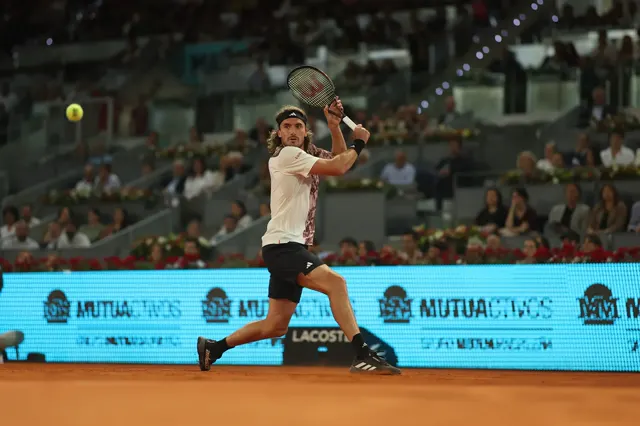
There is no single correct stroke: the Mouratoglou Method adapts technique to each player’s profile. At the Mouratoglou Academy in Biot, on the French Riviera, our coaches help you choose and build the backhand that suits you. Juniors work on it during the Performance Camp Junior, adults during the Performance Camp Adult. See also the one-handed backhand of Stefanos Tsitsipas, who trained at the Academy, then compare our tennis camps and book online.
 Ages 9–17Full daysBoarding optionPerformance Camp JuniorThe intensive camp for young players: technique, tactics, fitness and mindset, 4 players per coach.DISCOVER
 Frequently asked questions
Which backhand should a beginner choose?
The two-handed backhand in the vast majority of cases. It is more stable and quicker to learn, especially for children and less muscular players.
Is the one-handed backhand more powerful?
It can be, thanks to its reach and range of motion, as with Wawrinka. But it requires excellent technique and footwork to be consistent.
Why do so few pros hit a one-handed backhand?
Faster, heavier topspin, aggressive returns and very early learning all favour the two-hander, which is more stable on high balls.
Can I switch backhands as an adult?
Yes, but accept an adjustment period of several months. It is worth it if your current backhand really limits your game or causes pain.
Should a two-handed player learn the slice?
Yes. The one-handed slice is essential for defending, approaching the net and varying the pace, whatever your main backhand.